
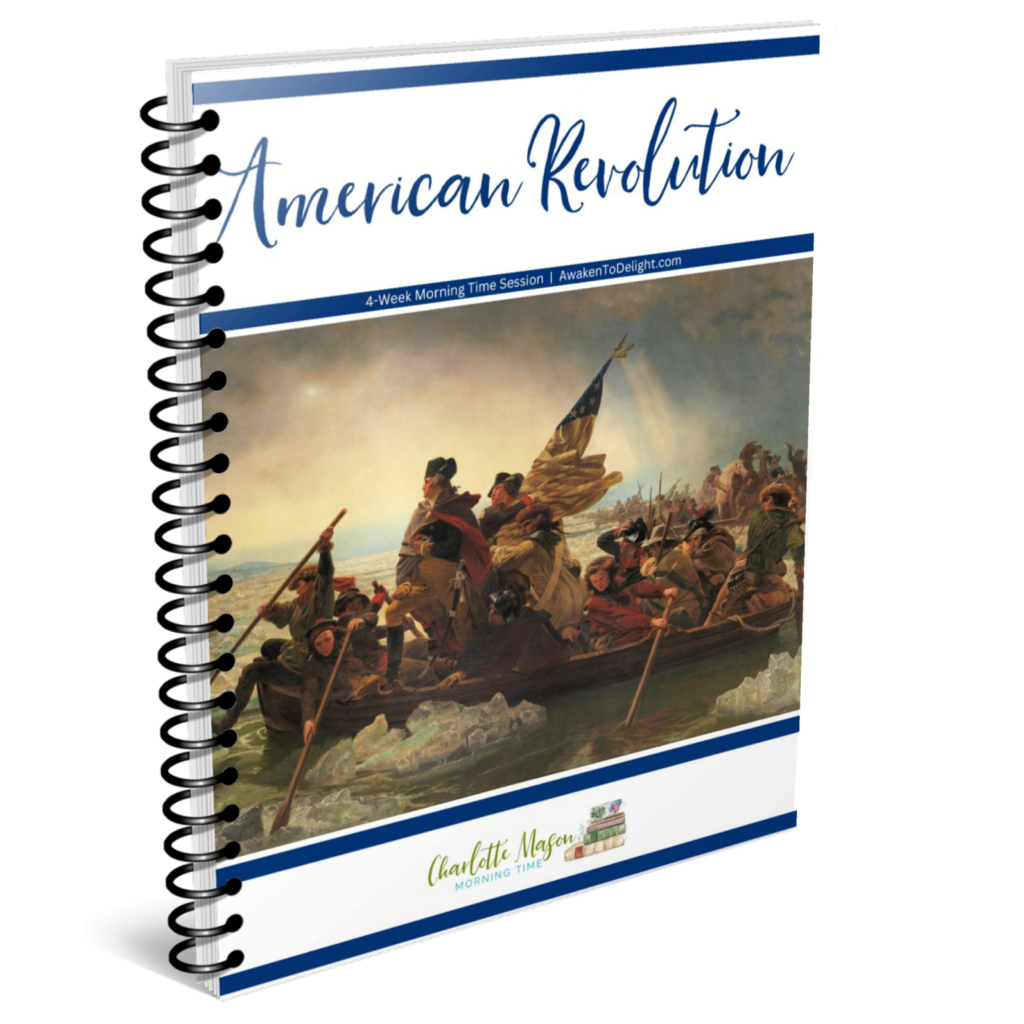
Welcome to the American Revolution Morning Time Session!
Click on the button above to download the entire PDF,
or download only the sections you want below.
Schedule
Recommended Books
Prayer & Scripture Memorization
For Bible reading, we will make suggestions for your morning time reading. However, if you’d prefer a more in depth schedule, we recommend checking out various plans that will help you read the Bible through.
For a one-year plan, we recommend YouVersion’s One Year Bible: https://www.bible.com/reading- plans/60. You can also listen to it being read aloud on the app.
Download a two-year reading plan from the Gospel Coalition here: https://media.thegospelcoalition.org/static-blogs/tgc/files/2010/12/TGC-Two-Year-Bible-Reading- Plan1.pdf
If you prefer to go even slower, Ambleside Online offers three, four, and five-year Bible reading plans: https://www.amblesideonline.org/L/Lbiblesch.html
For the American Revolution session you will read through the book of Romans, and highlight other scriptures that speak of freedom/liberty.
Your students will memorize Psalm 31:23-24, Washington’s Prayer for the United States of America (alternatively, you can have your family memorize and pray 1 Timothy 2:1-3 over your government leaders). And finally, the poem, “Flawless His Heart,” by James Russell Lowell.
Psalm 31:23-24
“Oh, love the Lord, all you His saints! For the Lord preserves the faithful, And fully repays the proud person. Be of good courage, And He shall strengthen your heart, All you who hope in the Lord.”
1 Timothy 2:1-3
“I urge, then, first of all, that petitions, prayers, intercession and thanksgiving be made for all people — for kings and all those in authority, that we may live peaceful and quiet lives in all godliness and holiness. This is good, and pleases God our Savior.”
Father God, I am grateful for the United States of America (or insert your country). Thank You for all the blessings You have given us as a nation. According to Your Word, I pray for every political leader and representative to come to the full knowledge of the the truth and to receive godly wisdom so that we will be able to live quiet and peaceful lives. In Jesus’ name, Amen.
Artist Study
This session’s featured artist is John Trumbull. We’ve included six art selections for your kids and teens to use for picture study. They are:
- Portrait of George Washington and William ‘Billy’ Lee
- Declaration of Independence
- Portrait of Alexander Hamilton
- The Surrender of Lord Cornwallis
- General George Washington Resigning his Commission
- The Death of General Warren at the Battle of Bunker’s Hill, June 17, 1775
Composer Study
Our featured composer is Christian Philipp Emanuel (C.P.E.) Bach. We’ve included six of his pieces (with links to each) to listen to. They are:
- Solfeggietto in C minor (H220, Wq. 117:2)
- Concerto for Harpsichord or Fortepiano and Strings in E Minor Wq. 15
- String Quartet No.14 D minor
- Cello Concerto in A minor, Wq. 170
- Quartet in G Major, Wq 95, H539
- Quartet in A Minor, Wq 93: II. Largo e sostenuto
Listen to each piece below:
Solfeggietto in C minor (H220, Wq. 117:2)
Concerto for Harpsichord or Fortepiano and Strings in E Minor Wq. 15
String Quartet No.14 D minor
Cello Concerto in A minor, Wq. 170
Carl Philipp Emanuel Bach – Quartet in G Major, Wq 95, H539
C.P.E. BACH // ‘Quartet in A Minor, Wq 93: II. Largo e sostenuto’ by Nevermind
Colonial Music
Aileen Aroon
George Washington’s Favorite Cotillion / Corn Riggs Are Bonny
Menuet
Ogni Dolce Aura
Hymn/Folk Song
Hymn
During the latter part of the 18th century, there was a controversy taking place throughout the Church in England and America. Many Christians believed that singing hymns instead of the “psalms of David” was erroneous.
In fact, one American preacher rode on horseback from Kentucky all the way to Philadelphia, Pennsylvania to protest “the great and pernicious error of adopting the use of Isaac Watts’ hymns in public worship…”
Watts, known as the “Father of English Hymnody,” wrote over 750 hymns during his lifetime. He advocated for using more poetic language in worship songs, drawing inspiration from Scripture rather than just directly quoting it. This idea revolutionized church music and paved the way for future hymn writers like Charles Wesley and Fanny Crosby.
In addition to writing hymns, Watts also penned works on theology and philosophy, even earning the praise of famed theologian John Wesley.
The hymn “I Sing the Mighty Power of God” was written in 1715 as part of a collection of songs for children, and was originally entitled, “Praise for Creation and Providence.” It is based on Psalm 150, which praises God for His power and might. It has been a staple in many denominations for centuries and continues to be sung today.
Listen to the music and sing along with it below:
Folk Song
The song “Yankee Doodle” is a traditional American song that dates back to the 18th century. Its tune is thought to be derived from a much older English folk song/nursery rhyme, “Lucy Locket.”
The lyrics are:
Lucy Locket lost her pocket,
Kitty Fisher found it;
Not a penny was there in it,
Only ribbon round it.
The lyrics we know as “Yankee Doodle” were believed to have been written by British composer George Mudge in 1775, and were originally sung by British troops during the Revolutionary War to mock the Americans because of their ragtag appearance.
After the War of 1812, “Yankee Doodle” grew in popularity and eventually became a patriotic song. The words have often been changed or added to depending on the situation. For example, during the Civil War, both Union and Confederate soldiers would sing different versions with various lyrics that mocked their opponents.
It has since been used in many different contexts, including political campaigns, military marches, and children’s songs.
Listen and sing along with it below:
Poetry
This session’s featured poet is Phillis Wheatley. We’ve included five poetry selections for your kids and teens to read, listen to, memorize, and recite. They are:
- Liberty and Peace
- An Hymn to the Morning
- An Hymn to the Evening
- On Virtue
- On Imagination
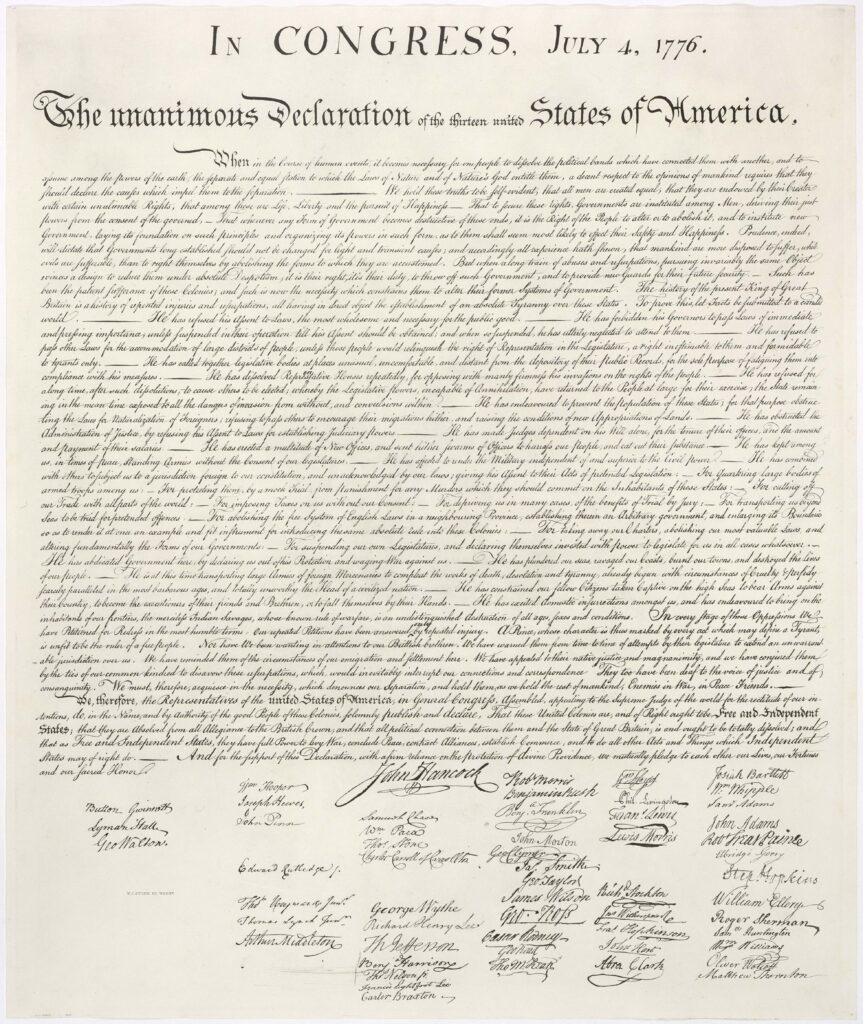
For copywork, we have included Zaner-Bloser style handwriting sheets for primary, elementary, and cursive, as well as college ruled for older students of The Declaration of Independence.
Copywork
Tea Times
In this session we have some fun Early American recipes to try for teatimes: Apple Tansey, Queen Cakes, Molasses Cookies, Johnny Cakes, Spoon Bread, and Blackberry Fool.
In the Spirit of ’76, our teatimes will be called “Liber-Teas.” We will have a Poetry teatime, a Speech teatime, a Fable teatime, and a Story teatime
Liber-Tea #1: “Paul Revere’s Ride,” by Henry Wadsworth Longfellow
Liber-Tea #2: Patrick Henry’s famous “Give Me Liberty or Give Me Death” speech to the Virginia Convention.
Liber-Tea #3: “The Wolf and the House Dog,” by Aesop
Liber-Tea #4: “Molly Pitcher: The Brave Gunner of the Battle of Monmouth,” by Kate Dickinson Sweetser
Liber-Tea #5: “America: A Prophecy, Preludium” by William Blake
Liber-Tea #6: A Fine Dessert by Emily Jenkins & Sophie Blackall
(Note- this is a link to a read-aloud of this book, though you can choose to get your own copy to read at home here if you prefer!)
Shakespeare
For our Shakespeare selection, we have chosen “Measure for Measure.”
Read it from Charles & Mary Lamb’s Tales of Shakespeare in the following pages. But we also recommend reading the actual play together as a family if you can. (We will link to the Folger Library for this.)
Your older kids and teens may enjoy watching a movie adaptation (please pre-screen these first). And if you can take in a live performance, your family will never forget it!
We are including a link on our website to watch a pre-recorded stage performance of “Measure for Measure” by the Texas Shakespeare Festival.
Watch a performance of Measure for Measure by the Texas Shakespeare Festival below:
Nature Study
Each Friday morning, you will go through two of our nature cards. They are labeled in the upper right corner with the corresponding week. These are short, factual cards with images to help your child become familiar with objects in the natural world.
As you progress through our sessions, you may find it handy to keep your past nature cards in a binder for easy reference when your children come across a familiar object. These seeds you are planting will grow into a wonderful garden of knowledge for your children in years to come.
As you explore nature outside your home, watch and listen for newly discovered delights.
Handicraft
For our handicraft lesson, we will recreate a game played in Colonial times (but dating as far back as the Roman Empire) known as Nine Men’s Morris.
This is a two-person strategy game played on a board.
We have included instructions to create a leather “travel” game board, but the game can also be created on wood, cardboard, a stone paver, or even in the dirt using rocks for “men.”
Art Lesson
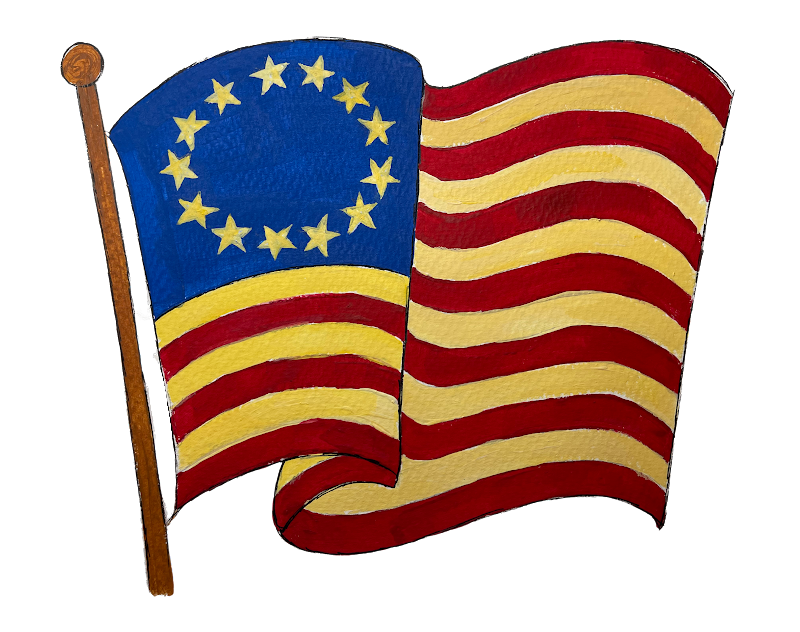
In this lesson, we are going to create an “antiqued” Betsy Ross-style flag that is often dated around 1776, during the initial stages of the American Revolutionary War. The flag features thirteen alternating red and white stripes and a circle of thirteen white stars in the blue field, symbolizing the original thirteen American colonies.
Supplies needed:
- Watercolor paper (or canvas)
- Acrylic paints (red, white, blue, and brown — yellow is optional for the “antique” look)
- Paint brushes (medium or small flat)
- Optional: White Sharpie or gel pen
- Optional: Black permanent pen
- Paper plate, paper towel, jar of water
History & Geography
Solfa
Charlotte Mason incorporated solfa lessons twice a week for about 10 minutes each. These lessons are intended to be repeated and you can stay on any lesson for as long as you like. Here is the YouTube channel Lara and her boys enjoy and recommends for practicing solfa, Children of the Open Air:
Brush Drawing
Brush drawing builds motor and observation skills. We have included a link to videos by Bestowing the Brush below which are great for all ages to learn together:
