Let your kids create a beautiful Book of Centuries to record historical events, as well as facts that are relevant to them. We’ll show you how!

What is a Book of Centuries?
Children are hands-on learners. We all know this: the more children engage with a subject, the easier it is for them to remember what they learned. Charlotte Mason understood this, and knew that while history is vital to a child’s education, all the books in the world won’t help your children truly learn if they don’t first make the connection between the past and the present.
Enter: the Book of Centuries. What is that, you may ask?
A Book of Centuries is simply a notebook in which to record historical events. Rather than spreading a timeline along a wall, the historical facts are kept inside the notebook. Kids and teens can use it to record what they learned about the various centuries throughout history. But rather than simply focus soley on historical events, they are also encouraged to document events they personally find interesting.
Each student can keep their own, or a family can create one Book of Centuries to which everyone can contribute.
Inside, two pages are dedicated to a single century. One side is lined and numbered for recording historical events, the names of famous people, and discoveries that shaped the course of history; the other is blank to allow the student to illustrate events and people from that century.
Below are examples from the PNEU school student, Eve Anderson (1894-1952). Click here and here to see the entire century books.
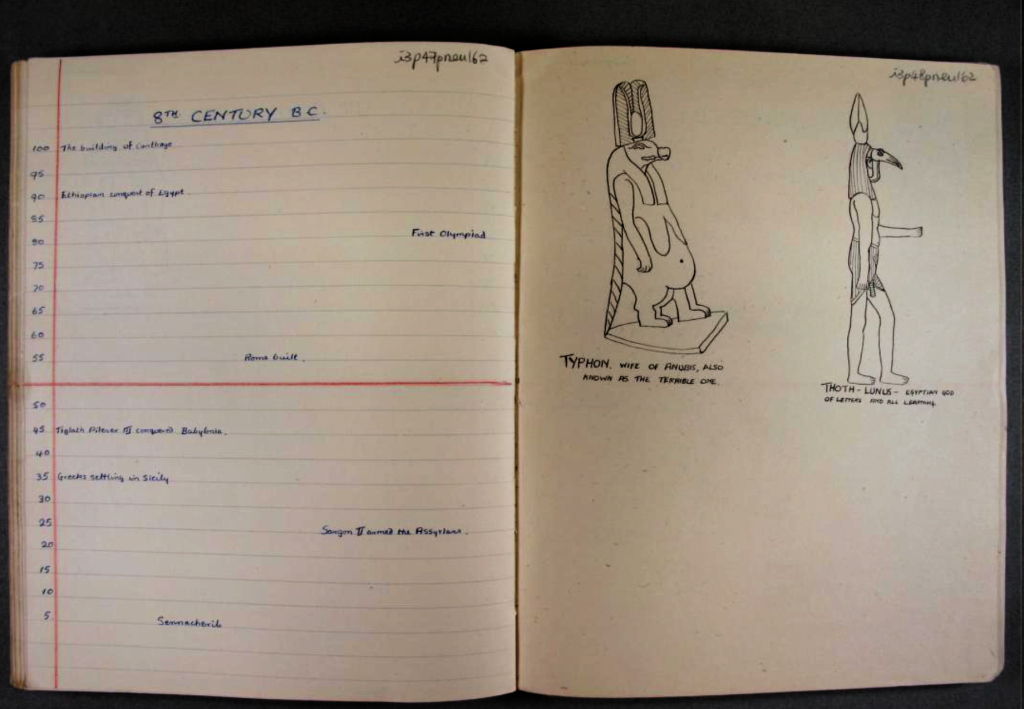

In essence, the purpose of the Book of Centuries gives students a way to organize (and narrate) what they learn and provide them with a visual representation of how moments in the past affected our present and future. In this way, each student can create a personalized setup, allowing them the freedom to lean into their special interests and learn about things that fascinate them.
Origins of the Book of Centuries, or Century Book
Gertrude M. Bernau was trained under Charlotte Mason at the House of Education in 1894, and became the principal of a PNEU school for girls in London in 1906. She wrote that a Book of Centuries “should bear witness to a liberal and generous diet of History…”
She explained in the “Parents Review,” the origins…
The late Mrs. Epps advocated in her “British Museum for Children” the keeping of a note-book, each page representing a century, in which one could draw sketches of objects in the Museums, and write notes of the principal events.
Parents Review, Volume 34, 1923
Charlotte Mason loved this idea and therefore had students begin keeping a Book of Centuries when they were 10 years old, and continue it throughout the course of their education. Eventually the notebook would become a beautiful keepsake to cherish when they were older.
Making Your Own Book of Centuries
Each student (or family, if preferred) should begin with a blank notebook. Then start writing in the centuries on the ruled pages. You’ll be working backwards, so the first page could be for the story of creation. The next pair of pages can begin with things like “The Stone Age” (or Paleolithic/Neolithic) and “The Bronze Age” and “The Iron Age,” then proceed from there with the 30th Century B.C., followed by 29th Century B.C., and so on, until you reach 1st Century B.C. and 1st Century A.D., after which you’ll proceed with 2nd Century A.D., and so on.
(When writing everything out, make sure to leave a few blank pages at the back for a place to add maps, graphics, museum cutouts, etc.)
Once you’ve recorded the different centuries, add a line down the length of the paper for a margin, enough room to write numbers. Each line represents 5 years, so in the B.C. era, start with 100 and work your way down, with 5 years per line. (So 100, 95, 90, etc.) In the A.D. era, start with 5 and work your way down (5, 10, 15, etc.)
In Miss Bernau’s own words…
I am afraid heading the pages is rather a wearisome business, but if you do a few each week, it will not seem so long.
An important thing to remember is that it doesn’t have to be perfect. After all, students will be working in this for years to come. There are bound to be a few mistakes.
Try not to overcrowd the pages with entries—keep them simple and orderly—and don’t use more than two pages per century, even if one has more events than another.
You can read aloud to your students or have them take turns, then work together to find important people, places, and events to document. Set aside a regular time for your student to work in their book so that they can consistently document and illustrate events. Encourage them to be creative with the design and use of color.
Want a Ready-Made Book of Centuries?
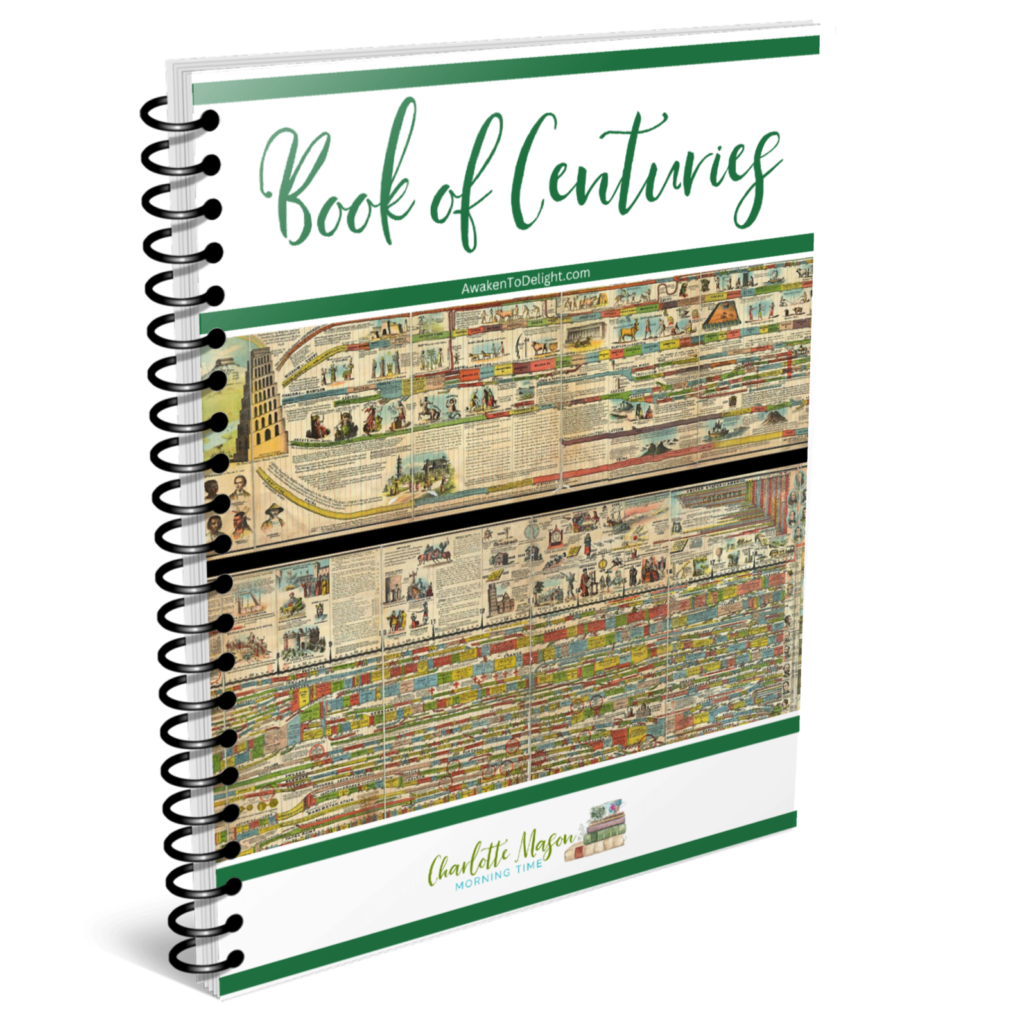
Not interested in going to a lot of trouble having your kids create their own (or doing it for them)? No worries! We’ve created a Book of Centuries according to the specifications of the ones sold by the “Parents Union Schools” below, but a bit more modern. 😉 And you can grab it for only $10!


Get started this year with a Book of Centuries and watch history come alive for your kids and teens!
Pin Me!