
Welcome to the World War I Morning Time Session!
Click on the button above to download the entire PDF,
or download only the sections you want below.
Schedule
Recommended Books
Prayer & Scripture Memorization
For Bible reading, we will make suggestions for your morning time reading. However, if you’d prefer a more in depth schedule, we recommend checking out various plans that will help you read the Bible through.
For a one-year plan, we recommend YouVersion’s One Year Bible: https://www.bible.com/readingplans/60. You can also listen to it being read aloud on the app.
Download a two-year reading plan from the Gospel Coalition here:
https://media.thegospelcoalition.org/static-blogs/tgc/files/2010/12/TGC-Two-Year-Bible-ReadingPlan1.pdf
If you prefer to go even slower, Ambleside Online offers three, four, and five-year Bible reading
plans: https://www.amblesideonline.org/L/Lbiblesch.html
This session, we will learn Psalm 23 and focus on writing and memorizing John 15:13.
Artist Study
This session’s featured artist is George Braque. We’ve included six art selections for your kids and teens to use for picture study. They are:
- Houses at l’Estaque (1908)
- Violin and Candlestick (1910)
- The Olive Tree Near l’Estaque (1909)
- Fruit Dish, Ace of Clubs (1913)
- Man With a Guitar (1914)
- Fruit Dish (1908-1909)
Composer Study
Our featured composer is Irving Berlin. We’ve included six of his pieces (with a link to each) to listen to. They are:
- Alexander’s Ragtime Band
- The International Rag
- When I Lost You
- Ragtime Soldier Man
- Smile and Show Your Dimple
- That Mysterious Rag
Listen to the pieces below:
Alexander’s Ragtime Band
The International Rag
When I Lost You
Ragtime Soldier Man
Smile and Show Your Dimple
That Mysterious Rag
Hymn/Folk Song
Hymn
The hymn for this session is, “O God, Our Help in Ages Past.” This beloved hymn was written by the English minister Isaac Watts, who published it in 1719. During his lifetime, Watts wrote 750 hymns and is known as the “godfather of English hymnology.” For this work, he wrote nine stanzas based on Psalm 90, an ancient poetic prayer from the Bible. It’s one of his most popular hymns and is still sung today in churches and by individuals all over the world. The song has been cherished for many years as a beautiful and hopeful expression of faith during hard times.
Listen to the music and sing along with it below:
O God, Our Help in Ages Past– Choral
O God, Our Help in Ages Past
Folk Song
Our folk song for this session is “It’s a Long Way to Tipperary.” This popular Irish folk song was originally written by Jack Judge and co-written with Harry Williams in 1912. It became the unofficial marching song of the British Expeditionary Force during World War I, having been sung in popular music halls across England prior to the war. The song tells the story of a soldier bidding farewell to his sweetheart in Tipperary, Ireland, as he is sent off to war. The lyrics reflect the sense of longing for home felt by many of the soldiers, while also expressing a hopefulness for safety and return.
Listen and sing along with it below:
It’s a Long Way to Tipperary
Poetry
This session features various poems about World War I. We’ve included six selections for your kids and teens to read, listen to, memorize, and recite. They are:
- For All We Have and Are (Rudyard Kipling)
- Belgium (Edith Wharton)
- The Wife of Flanders (G. K. Chesterton)
- In Flanders Fields (John McCrae)
- For the Fallen (Laurence Binyon)
- Ode to a Snowdrop During Wartime (Namur King)
For copywork, we have included Zaner-Bloser style handwriting sheets for primary, elementary, and cursive, as well as college-ruled for older students. The poems we have chosen are:
- The Wife of Flanders (G. K. Chesterton)
- In Flanders Fields (John McCrae)
- For the Fallen (Laurence Binyon)
- Ode to a Snowdrop During Wartime (Namur King)
Copywork
Tea Times
In this session, we are giving you six recipes with our hospitality tea: Ration Scones, ANZAC Biscuits, Trench Cake, Apricot Charlotte, Jam Tart, Gingerbread Cup Pudding.
We will also have three Storytime teas, a Fairy Tale teatime, Mythology teatime, and a Fable teatime:
Storytime Tea 1: The Bowmen, by Arthur Machen
Storytime Tea 2: His Last Bow, by Sir Arthur Conan Doyle
Storytime Tea 3: The Kidnapped Prime Minister, by Agatha Christie
Fairy Tale Tea: The Old Woman In The Woods, by the Brothers Grimm
Mythology Teatime: Tanglewood Tales: “Circe’s Palace,” by Nathaniel Hawthorne
Fable Teatime: “The Ass and the Charger,” by Aesop
Shakespeare
For our Shakespeare selection, we have chosen “Two Gentlemen of Verona.”
Read it from Edith Nesbit’s “Beautiful Stories from Shakespeare” in the following pages. We also recommend reading the actual play together as a family if you can.
Your older kids and teens may enjoy watching a movie adaptation (please pre-screen these first). And if you can take in a live performance, your family will never forget it!
We are including a link below to watch a pre-recorded stage performance:
Watch a performance of “The Two Gentlemen of Verona” by Hofstra University below:
Nature Study
Each Friday morning, you will go through two of our nature cards. They are labeled in the upper right corner with the corresponding week. These are short, factual cards with images to help your child become familiar with objects in the natural world.
As you progress through our sessions, you may find it handy to keep your past nature cards in a binder for easy reference when your children come across a familiar object. These seeds you are planting will grow into a wonderful garden of knowledge for your children in years to come.
As you explore nature outside your home, watch and listen for newly discovered delights.
Handicraft
For our handicraft lesson, we will sew felt pansies based on the paper pansies worn in Great Britain on Remembrance Day (celebrated on November 11th each year) in honor of armed forces members who have died in the line of duty.
Several years ago, we were in England in November, and ladies were selling paper poppies. I bought a “bouquet” of them to bring back to the States.
The tradition of wearing paper poppies on Remembrance Day in Britain has its roots in the aftermath of World War I. The poppy, a bright red flower, became symbolically associated with the conflict due to the famous war poem “In Flanders Fields,” written by Lieutenant Colonel John McCrae, where he described how poppies grew amidst the graves of soldiers in war-ravaged fields.
Art Lesson
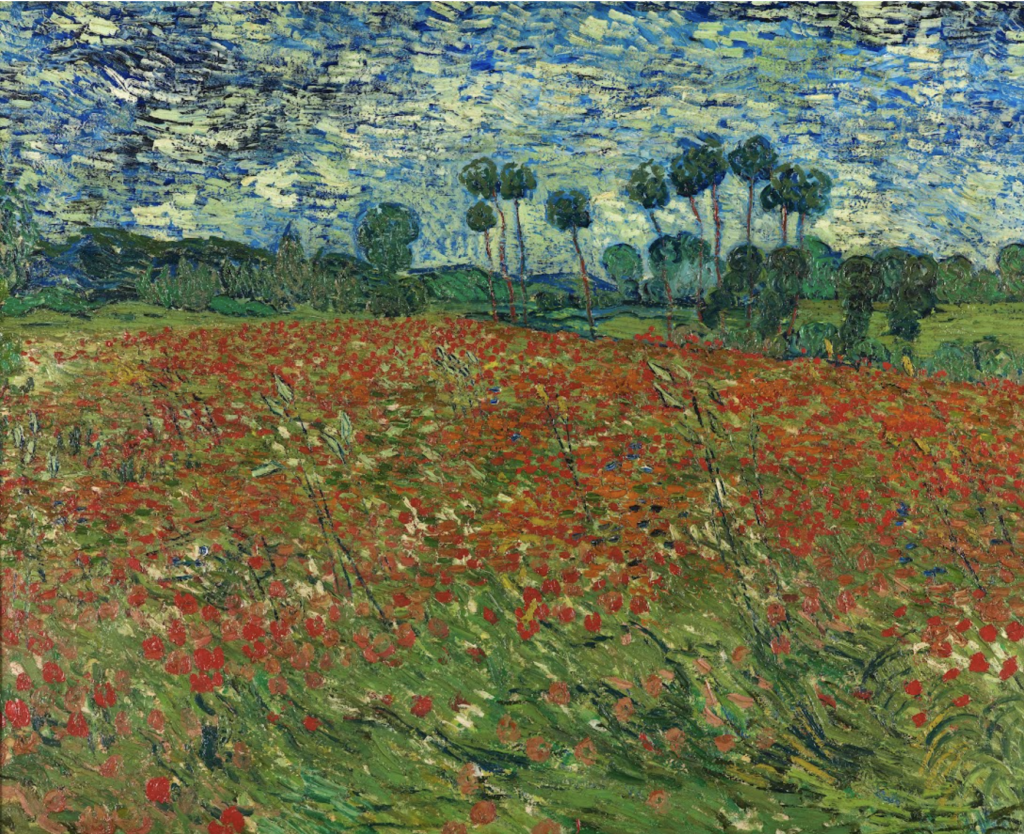
In this lesson, we are going to recreate Vincent van Gogh’s painting, Poppy Field, as a tribute to the poem “In Flanders Field,” by John McCrae.
Supplies needed:
- Watercolor paper (or canvas)
- Acrylic paints (black, blue, green, red, yellow, and white)
- Paint brushes (medium or small flat)
- Paper plate, paper towel, jar of water
History & Geography
For history and geography, you can read through the major battles of WWI that we have included below. We have also included several maps of Europe for map drills.
For your younger children, this timeline is a good overview for further study: https://kidskonnect.com/history/world-war-i/
For middle elementary and up students, there are several excellent documentaries on Curiosity Stream.
See many photographs from World War I in the National Archives:
https://www.archives.gov/topics/wwi
Solfa
Charlotte Mason incorporated solfa lessons twice a week for about 10 minutes each. These lessons are intended to be repeated and you can stay on any lesson for as long as you like. Here is the YouTube channel Lara and her boys enjoy and recommend for practicing solfa, Children of the Open Air:
Brush Drawing
Brush drawing builds motor and observation skills. We have included a link to videos by Bestowing the Brush below, which are great for all ages to learn together:
