

Welcome to the Springtime Morning Time Session!
Click on the button above to download the entire PDF,
or download only the sections you want below.
Schedule
Recommended Books
Prayer & Scripture Memorization
For Bible reading, we will make suggestions for your morning time reading. However, if you’d prefer a more in depth schedule, we recommend checking out various plans that will help you read the Bible through.
For a one-year plan, we recommend YouVersion’s One Year Bible: https://www.bible.com/readingplans/60. You can also listen to it being read aloud on the app.
Download a two-year reading plan from the Gospel Coalition here:
https://media.thegospelcoalition.org/static-blogs/tgc/files/2010/12/TGC-Two-Year-Bible-ReadingPlan1.pdf
If you prefer to go even slower, Ambleside Online offers three, four, and five-year Bible reading
plans: https://www.amblesideonline.org/L/Lbiblesch.html
This session, we will learn the St. Gregory’s Easter Prayer and focus on writing and memorizing John 11:25 and Matthew 28:1-9.
Artist Study
This session’s featured artist is Berthe Morisot. We’ve included four art selections for your kids and teens to use for picture study. They are:
- In the Bois de Boulogne
- Eugène Manet and His Daughter at Bougival
- After Luncheon
- The Garden at Maurecourt
Composer Study
Our featured composer is Antonio Vivaldi. We’ve included four of his pieces (with links to each) to listen to. They are:
- “La Primavera” (Spring)
- “L’estate” (Summer)
- “L’autunno” (Autumn)
- “L’inverno” (Winter)
Listen to each piece below:
“La Primavera” (Spring)
“L’estate” (Summer)
“L’autunno” (Autumn)
“L’inverno” (Winter)
Hymn/Folk Song
Hymn
The powerful words of the hymn, “Christ the Lord is Risen Today,” were written by Charles Wesley in 1739. Wesley was an Anglican priest and one of the founders of Methodism. He wrote over 6,000 hymns during his lifetime, and this particular hymn remains an important part of Christian worship today.
Wesley wrote the words that were set to a traditional Easter melody known simply as “Easter Hymn.” The tune first appeared in a collection called Lyra Davidica by John Walsh, but the more well-known arrangement was published in 1749.
The hymn quickly became popular and was translated into many languages. It has been sung in churches all over the world, with some of them using different musical arrangements. Its timeless words have inspired many people and can still be heard today in both traditional hymn books and contemporary worship songs.
Throughout its long history, this hymn has continued to be an anthem of hope at Easter. The simple, yet profound words remind us of the joyous occasion that marks the resurrection of Jesus Christ and brings comfort to those who seek hope in difficult times.
“Christ the Lord is Risen Today” is a beloved hymn that has endured for centuries due to its timeless message of hope. This year, as we celebrate Easter, let us take the time to pause and reflect on its message of Resurrection and rejoice in God’s glory.
Listen to the music and sing along with it below:
* For more Easter Hymns, check out Ambleside Online’s list here.
Folk Song
The origins of the folk song “English Country Garden” can be traced back to the 18th century. The song is believed to have originated in Devon or Cornwall and is thought to have been written for “Morris Dancing,” a choreographed English folk dance based on rhythmic stepping and the use of sticks, handkerchiefs, or swords. The lyrics were written by an unknown author, but the melody was derived from an older tune known as “The Dumble Derry.”
In the 19th century, the song gained wider recognition when it was published in 1810 by Thomas Hardy. The collection was titled Popular Music of the Olden Time and included several versions of “English Country Garden.” From there, it became a popular folk song and was spread across the British Isles.
The first recorded version of “English Country Garden” was released in 1918 by Percy Grainger. It quickly gained popularity, especially among the upper classes, as it was chosen to be performed at concerts and events. By the 20th century, it had become an iconic folk song, and it is still widely known today.
The lyrics of “English Country Garden” evoke a sense of nostalgia for the beauty of nature and the peacefulness of rural life. The song is also symbolic of England’s pastoral heritage, with references to daffodils, hearts-ease, and other phlox. It serves as a reminder of the beauty that can be found in small moments; even if we can’t escape our daily lives and take a trip to the countryside, we can still appreciate the stunning scenery of the English Country Garden.
Listen and sing along with it below:
Poetry
This session’s featured poet is E. E. Cummings. We’ve included four poetry selections for your kids and teens to read, listen to, memorize, and recite. They are:
- [in Just-]
- (“in/Spring comes(no-…”)
- when faces called flowers float out of the ground
- sweet spring is your
For copywork, we have included Zaner-Bloser style handwriting sheets for primary, elementary, and cursive, as well as college ruled for older students. The poems we have chosen are:
- when faces called flowers float out of the ground
- sweet spring is your
Copywork
Tea Times
In this session, we are giving you four Spring-themed recipes for our hospitality tea: Crustless Quiche, Butterfly-Shaped Cucumber Sandwiches, Honey Cookies, and Blueberry Scones with Lemon Glaze.
We will also have two Storytime teas, a Mythology teatime, and a fable teatime:
Storytime Tea 1: Winnie the Pooh, Chapter I: “In Which We Are Introduced to Winnie-the-Pooh & Some Bees & the Story Begins” by A.A. Milne
Storytime Tea 2: Anne of Green Gables, Chapter XXI: “A New Departure in Flavorings” by L.M. Montgomery
Mythology Teatime: A Wonder Book, “The Pomegranate Seeds” by Nathaniel Hawthorne
Fable Teatime: Aesop’s Fables, “The Bee and the Butterflies,” and “The Rose and the Butterfly” by Aesop
Shakespeare
For our Shakespeare selection, we have chosen the Bard’s Most Excellent and Lamentable Tragedy, “Romeo and Juliet.”
Read it from E. Nesbit’s Beautiful Stories from Shakespeare in the following pages. But we also recommend reading the actual play together as a family if you can.
Your older kids and teens may enjoy watching a movie adaptation (please pre-screen these first). And if you can take in a live performance, your family will never forget it!
We are including a link on our website to watch a pre-recorded stage performance of “Romeo and Juliet” by Emporia State University.
Watch a performance of Romeo and Juliet by ESU below:
Nature Study
Each Friday morning, you will go through two of our nature cards. These are short, factual cards with images to help your child become familiar with objects in the natural world.
As you progress through our sessions, you may find it handy to keep your past nature cards in a binder for easy reference when your children come across a familiar object. These seeds you are planting will grow into a wonderful garden of knowledge for your children in years to come.
As you explore nature outside your home, watch and listen for newly discovered delights.
Handicraft
Butterfly Corner Bookmark
The basic corner bookmark can be made with decorative paper and left as is, or any other animal shape can be added. This session, we are creating a lovely paper butterfly to adorn the bookmarks. For penmanship practice, a quote may be artfully drawn. Have fun with this useful handicraft!
Art Lesson
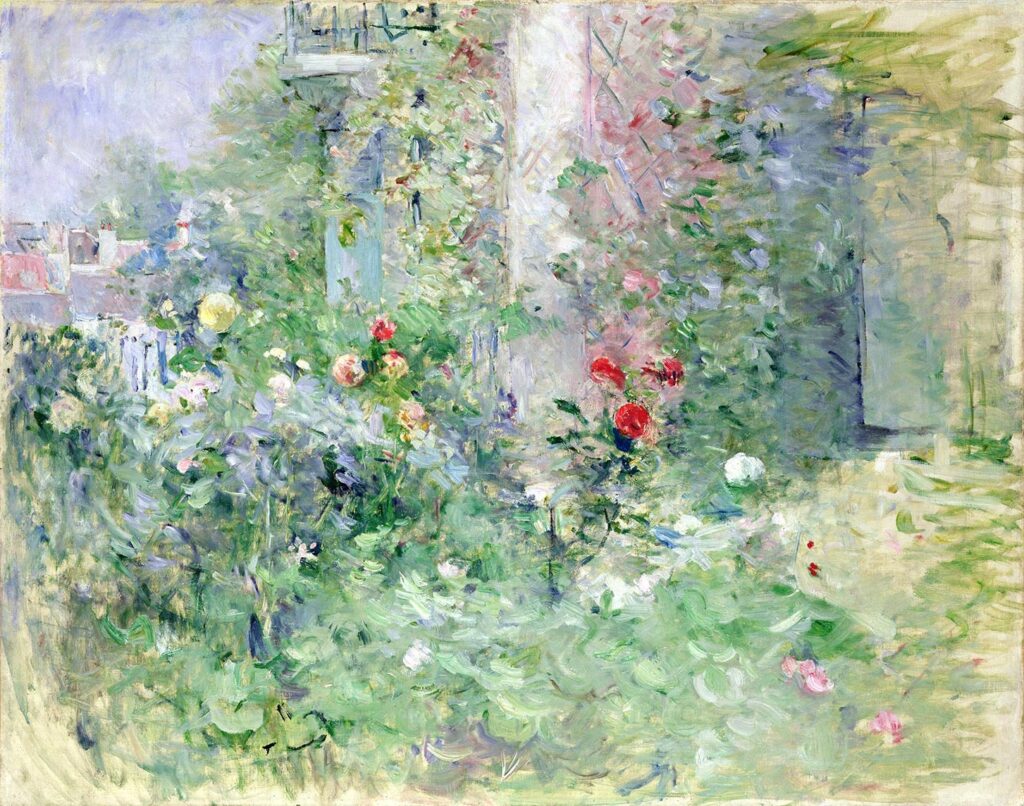
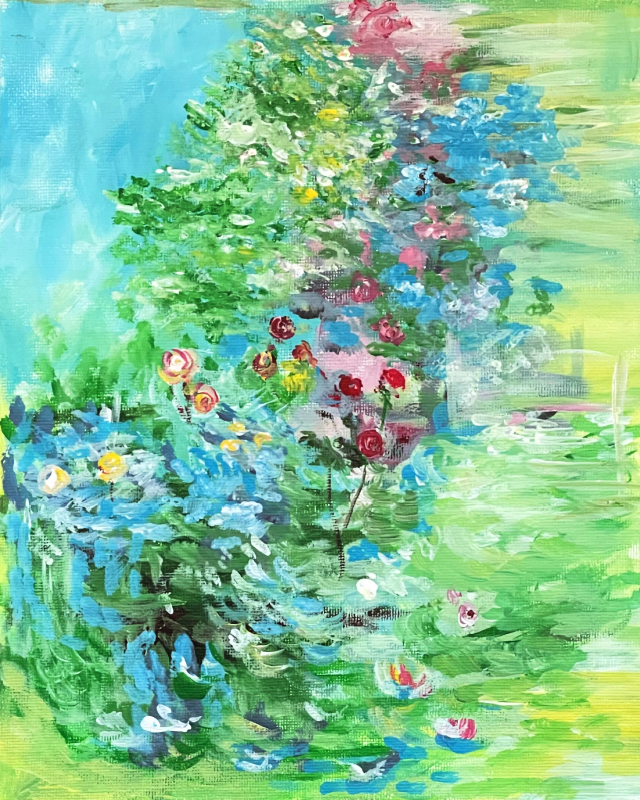
In this lesson, we are going to paint an Impressionist-style Spring Garden inspired by Berthe Morisot’s painting, Le jardin à Bougival.
Supplies needed:
- 8×10 canvas panel (or watercolor paper)
- Acrylic paints (I used green, blue, light yellow, red, and white)
- Paint brushes (medium flat, plus 1 or 2 small round brushes)
- Paper plate, paper towel, jar of water
History & Geography
There is no history or geography lesson for this session. However, we are including Natural History from The Fairy-Land of Science, (Weeks 25-30, Lectures IX: Bees in the Hive and X: Bees & Flowers) by Arabella B. Buckley.
Please Note: According to The Royal Society Journal of the History of Science, Buckley “… championed Darwinian evolution with particular emphasis on the mind and morals, in contrast to the prevailing emphasis on competition and physical survival.”
At the end of The Fairy-Land of Science, she also writes:
And so our wanderings in the Fairy-land of Science will not be wasted, for we shall learn how to guide our own lives, while we cannot fail to see that the forces of nature, whether they are apparently mechanical, as in gravitation or heat; or intelligent, as in living beings, are one and all the voice of the Great Creator, and speak to us of His Nature and His Will.
Whether or not you want to include these readings is, as always, at your own discretion as a parent.
Solfa
Charlotte Mason incorporated solfa lessons twice a week for about 10 minutes each. These lessons are intended to be repeated and you can stay on any lesson for as long as you like. Here is the YouTube channel Lara and her boys enjoy and recommends for practicing solfa, Children of the Open Air:
Brush Drawing
Brush drawing builds motor and observation skills. We have included a link to videos by Bestowing the Brush below which are great for all ages to learn together:
