

Welcome to the Medieval History Morning Time Session!
Click on the button above to download the entire PDF,
or download only the sections you want below.
Schedule
Recommended Books
Prayer & Scripture Memorization
For Bible reading, we will make suggestions for your morning time reading. However, if you’d prefer a more in depth schedule, we recommend checking out various plans that will help you read the Bible through.
For a one-year plan, we recommend YouVersion’s One Year Bible: https://www.bible.com/readingplans/60. You can also listen to it being read aloud on the app.
Download a two-year reading plan from the Gospel Coalition here:
https://media.thegospelcoalition.org/static-blogs/tgc/files/2010/12/TGC-Two-Year-Bible-ReadingPlan1.pdf
If you prefer to go even slower, Ambleside Online offers three, four, and five-year Bible reading
plans: https://www.amblesideonline.org/L/Lbiblesch.html
This session, we will learn Make Me an Instrument of Thy Peace and focus on writing and memorizing one scripture a week: Isaiah 26:3, John 14:27, John 16:33, Romans 15:13, Philippians 4:6-7, & Colossians 3:15.
Artist Study
This session’s featured artist is Simone Martini. We’ve included six art selections for your kids and teens to use for picture study. They are:
- Maestà
- St. Louis of Toulouse Crowning Robert of Anjou
- Petrarch’s Virgil
- Guidoriccio da Fogliano at the Siege of Montemassi
- Clare of Asissi
- Angel of the Annunciation
Composer Study
For this session, our music study will include Gregorian Chant, plus songs and instrumentals from Medieval England (featuring The Dufay Collective):
- Benedictine Monks of St Maurice and Saint Maur Clervaux,
- Luxembourg Playlist
- Psalm 90 & 91
- Gregoriano Monjes del Monasterio de Silos Playlist
- Miri It Is: Songs and Instrumental Music from Medieval England
Listen to each piece below:
Gregorian Chants by the Benedictine monks of St Maurice and Saint Maur Clervaux, Luxembourg
Psalm 90 & 91, Harpa Dei
Gregoriano Monjes del Monasterio de Silos
Medieval Songs & Instrumentals (Miri It Is Playlist)
Hymn/Folk Song
Hymn
The beautiful hymn “O Come, O Come, Emmanuel” is one of the most enduring sacred songs of the Christian faith, particularly associated with the Advent season. With origins dating back to the early medieval church, its lyrics are derived from the ancient “O Antiphons,” a series of prayers sung in monastic communities during the final days of Advent, each invoking a different title for Christ from Old Testament prophecy.
The hymn’s Latin text, Veni, Veni, Emmanuel, is believed to have been composed between the 8th and 12th centuries, while its solemn yet stirring melody first appeared in 15th-century France. Over the centuries, this hymn has transcended time and culture, with numerous translations
and adaptations, making it a cherished part of Christmas traditions worldwide and ensuring it endures to this day.
Listen to the music and sing along with it below:
Veni, Veni, Emmanuel / O Come, O Come, Emmanuel
Folk Song
One of the most famous pieces of medieval English music is “Sumer is Icumen In,” a lively musical round that celebrates the arrival of summer. Written in the mid-13th century, the song is a key milestone in Western music history. It’s one of the earliest known examples of English secular “polyphony,” a type of music where two or more melodies are sung together in harmony. Whether sung in its original language or a modern version, its melody continues to celebrate the arrival of summer across the centuries.
Listen and sing along with it below:
Sumer is Icumen In
Poetry
This session’s featured poet is Geoffrey Chaucer. We’ve included four poetry selections for your kids and teens with listening links so they can hear the poetry in Middle English, as well as links to interlinear translations or paraphrases to better understand what they are hearing.
Have fun with these poems by letting your students listen to each one first and see just how much they understand. Can they pick out words? Do they understand the gist of the poem?
- “Whan that Aprill…” (opening lines from Canterbury Tales)
- Controlling the Tongue
- The Love Unfeigned
- Balade
For copywork, we have included Zaner-Bloser style handwriting sheets for primary, elementary, and cursive, as well as college-ruled for older students. The poems and content we have chosen are:
- The Lady of Shalott
- O Come, O Come, Emmanuel (& Veni, Veni Emmanuel)
- Knights’ Code of Chivalry
Copywork
Tea Times
In this session, we are giving you six recipes for our hospitality tea: Plum Tart, Angel’s Food, Medieval Gingerbread, Applemoys, Fine
Cakes, & Custard.
We will also have three Storytime Teas and one Poetry Tea Time:
Storytime Tea 1: Legends That Every Child Should Know, “Beowulf,” by Hamilton Wright Mabie
Storytime Tea 2: The Tale of King Arthur and the Round Table, ”The Quest for the Holy Graal,” by Andrew Lang
Poetry Tea Time: “The Lady of Shalott,” by Alfred Tennyson
Storytime Tea 3: The Chaucer Story Book, “The Knight’s Tale,” by Eva March Tappan (A PDF has been included to download)
Plutarch
For our Plutarch selection, we have chosen the chapter “The Admiral of the Fleet,” a study of Cimon from The Children’s Plutarch: Tales of the Greeks, and included it on the following pages. The book may also be purchased on Amazon.
Nature Study
Each Friday morning, you will go through two of our nature cards. They are labeled in the upper right corner with the corresponding week. These are short, factual cards with images to help your child become familiar with objects in the natural world.
As you progress through our sessions, you may find it handy to keep your past nature cards in a binder for easy reference when your children come across a familiar object. These seeds you are planting will grow into a wonderful garden of knowledge for your children in years to come.
As you explore nature outside your home, watch and listen for newly discovered delights.
Handicraft
For our handicraft lesson, we will create a medieval-inspired heraldry bunting. We have intentionally kept this lesson simple so that everyone in the family can create together and even experiment with their own designs if desired.
Take this project to the next level by having your kids and teens research their family crests or create a unique design based on their values and interests, then design and paint a shield (using cardboard or wood) with their heraldry on it.
Art Lesson
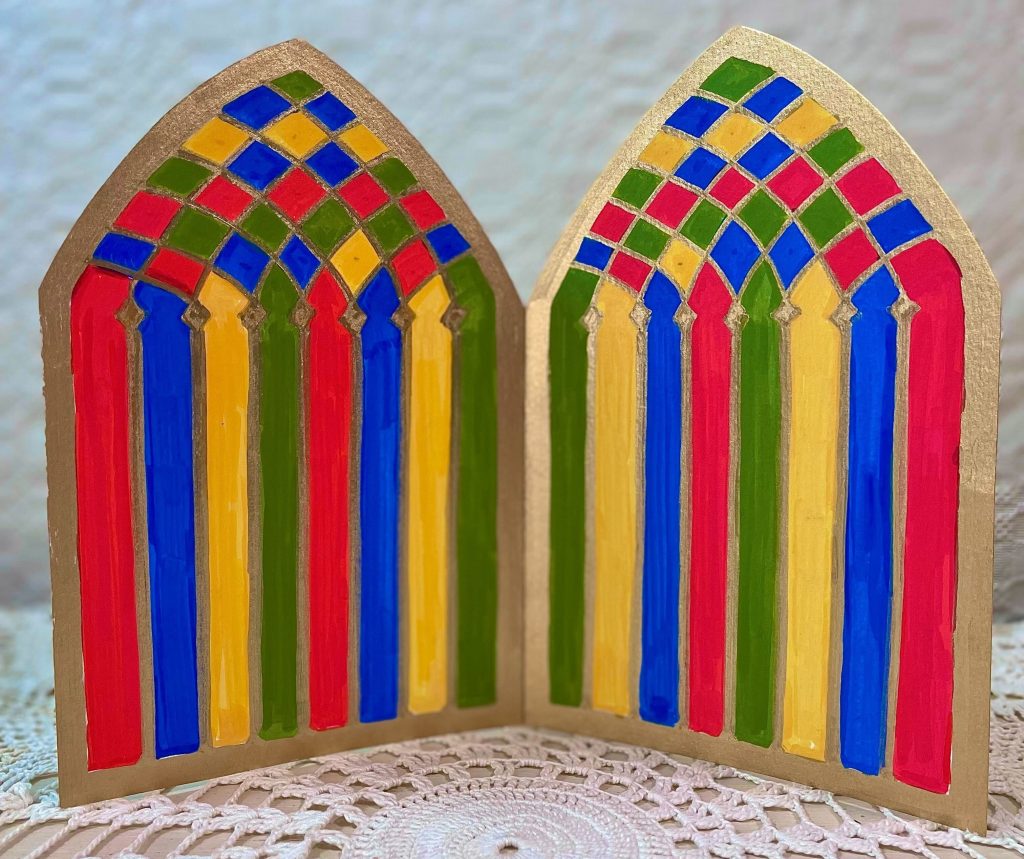
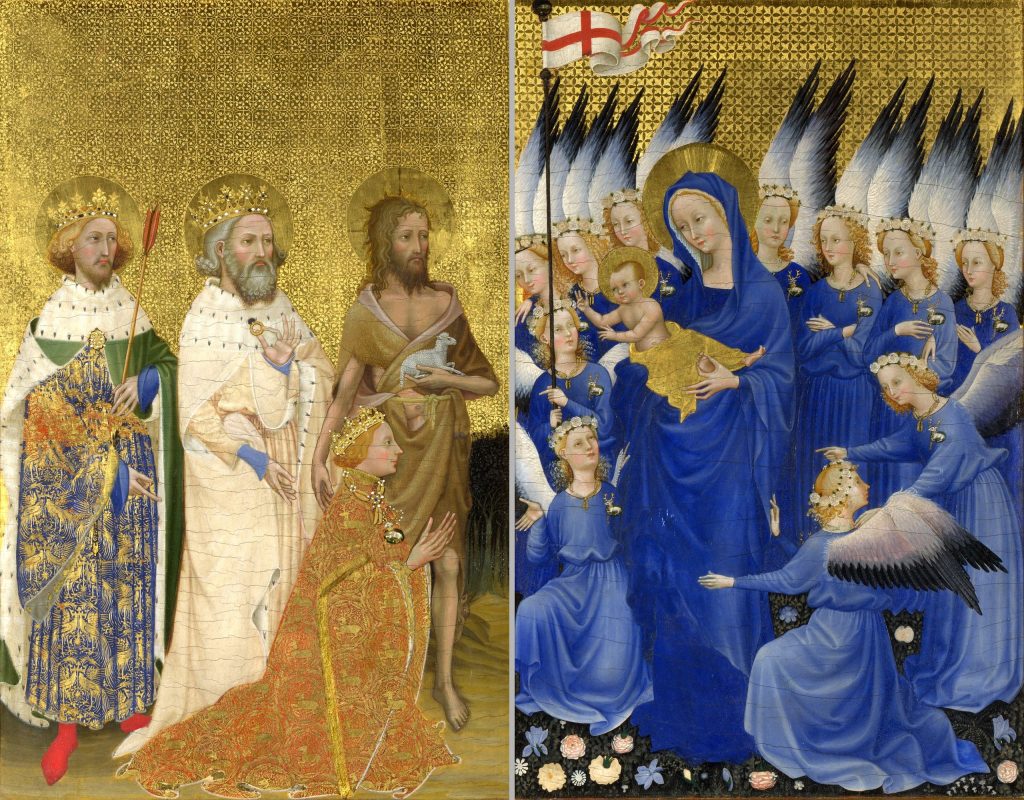
Medieval Diptych Art Lesson
During the Middle Ages, artists created beautiful and meaningful works of art on wooden panels called diptychs (DIP-tiks). A diptych is a two-panel artwork that is hinged or connected, allowing it to fold like a book. These pieces were often made as altarpieces, devotional paintings, or even personal prayer objects that people could carry with them. Many featured religious themes, gold leaf accents, and intricate details in the style of illuminated manuscripts.
For this project, we’ll create our own version of a medieval diptych using folded watercolor paper instead of wooden panels. We will also incorporate medieval architecture by painting in the style of a Gothic cathedral window.
Supplies needed:
- Watercolor Paper
- Markers (or acrylic paints) in traditional colors — I used blue, red, yellow, green, and metallic gold
- Ruler &/or triangle
- Pencil
- Scissors
- Bone folder (or something with a straight edge)
- Template
This is the Ohuhu Acrylic Markers set that I used.
Window Template
History & Geography
For geography, you can read chapters 17-22 of Richard Halliburton’s Book of Marvels: The Occident.
Older students can read The Story of Mankind, chapters 25-37.
In the link to your history curriculum, we have selected 3 maps for your family to study: a map of Europe after the fall of the Roman Empire, a map of the Byzantine Empire at the death of Justinian I, and a map of Europe at the height of the Middle Ages.
Below, we have included 9 videos for additional historical research covering topics such as the Crusades, the Hundred Years’ War, the Black Death, and more!
For further study:
Regional Maps of the Middle Ages
History of the Middle Ages
(Please pre-screen these articles.)
The First Crusade by Epic History
Magna Carta and the Constitution by Annenberg Classroom
Why Was the Hundred Years War So Significant? by Captivating History
What Made the Black Death so Deadly? by The Infographics Show
Joan of Arc: Martyr and a Patron Saint of France by World History Encylopedia
Ten Minute History- Charlemagne and the Carolingian Empire by History Matters
Eleanor of Aquitaine: the Medieval Queen of England and France in the High Middle Ages by World History Encyclopedia
The Life of St. Thomas Aquinas by Sanctus
William the Conqueror, the Norman who dared to invade England by FRANCE 24 English
Solfa
Charlotte Mason incorporated solfa lessons twice a week for about 10 minutes each. These lessons are intended to be repeated and you can stay on any lesson for as long as you like. Here is the YouTube channel Lara and her boys enjoy and recommends for practicing solfa, Children of the Open Air:
Brush Drawing
Brush drawing builds motor and observation skills. We have included a link to videos by Bestowing the Brush below which are great for all ages to learn together:
