
Welcome to the England Morning Time Session!
Click on the button above to download the entire PDF,
or download only the sections you want below.
Schedule
Recommended Books
Prayer & Scripture Memorization
For Bible reading, we will make suggestions for your morning time reading. However, if you’d prefer a more in depth schedule, we recommend checking out various plans that will help you read the Bible through.
For a one-year plan, we recommend YouVersion’s One Year Bible: https://www.bible.com/readingplans/60. You can also listen to it being read aloud on the app.
Download a two-year reading plan from the Gospel Coalition here:
https://media.thegospelcoalition.org/static-blogs/tgc/files/2010/12/TGC-Two-Year-Bible-ReadingPlan1.pdf
If you prefer to go even slower, Ambleside Online offers three, four, and five-year Bible reading
plans: https://www.amblesideonline.org/L/Lbiblesch.html
This session, we will learn the “Day by Day” Prayer of Saint Richard of Chichester, and focus on writing and memorizing John 15:4-8.
Artist Study
This session’s featured artist is Thomas Gainsborough. We’ve included five art selections for your kids and teens to use for picture study. They are:
- Gainsborough Self Portrait
- The Blue Boy
- Road from Market
- Frances Brown, Mrs. John Douglas
- The Gravenor Family
Composer Study
Our featured composer is Benjamin Britten. We’ve included four of his pieces (with links to each) to listen to. They are:
- The Young Person’s Guide to the Orchestra
- Four Sea Interludes from Peter Grimes
- War Requiem
- Simple Symphony
Listen to each piece below:
The Young Person’s Guide to the Orchestra
Four Sea Interludes from Peter Grimes
War Requiem
Simple Symphony
Hymn/Folk Song
Hymn
“Abide with Me” is a well-known Christian hymn that has brought people comfort for many years. It was written in 1847 by Henry Francis Lyte, a Scottish Anglican minister. Lyte wrote the hymn while he was very sick with tuberculosis and near the end of his life. He wanted to express his strong faith in God and his hope for God’s presence, even in hard times. The words “Abide with me” mean “stay with me,” and the hymn asks God to stay close during life’s struggles. It is a beloved song that comforts, honors tradition, and brings people together during times of hardship and joy alike.
Listen to the music and sing along with it below:
Abide with Me
Bonus: Abide with Me, Sung at the FA Cup
Folk Song
“Barbara Allen” is one of the most beloved and enduring folk songs in the English-speaking world. It’s a simple, sorrowful tale of love and regret that has been sung for hundreds of years—and it still touches hearts today. No one knows exactly who first wrote “Barbara Allen,” but it dates all the way back to the 1600s in England and Scotland. Over the years, “Barbara Allen” has been passed down from generation to generation by word of mouth and continues to be sung in households throughout the world. It’s a beautiful example of how folk music connects us to our past and reminds us how stories, even sad ones, can bring people together and teach lessons that are just as true today as they were centuries ago.
Listen and sing along with it below:
Barbara Allen
Poetry
This session’s featured poet is Edmund Spenser. We’ve included three of his poetry selections along with modern translations for your kids and teens to read, listen to, memorize, and recite. We have also included three additional England-themed selections from various writers. Our selections are:
- Excerpt from the Faerie Queene, Book I, Canto I, Stanzas I-V
- Excerpt from The Faerie Queene, Book V, Canto II, Stanza 39
- Excerpt from The Faerie Queene, Book V, Canto II, Stanza 43
- God Save the King
- Land of Hope and Glory
- This England by William Shakespeare
These selections are also available as copywork. We have included Zaner-Bloser style handwriting sheets for primary, elementary, and cursive, as well as college-ruled for older students.
Copywork
Tea Times
In this session, we wanted to highlight British culture by including a true English Afternoon Tea. Along with our recipes, we have several additional menu ideas for you to mix and match to your families’ tastes! For your afternoon tea, we have Victoria Sponge Cake, Scones and Devonshire Cream, Crumpets, and Cucumber Sandwiches, as well as more ideas for different cakes, breads, sandwiches, and teas for you to choose from!
We will also have two Story Time teas and two Fairy Tale teas:
Story Time Tea 1: Stories from the Faerie Queen, “St. George and the Dragon” by Jeanie Lang
Story Time Tea 2: The Sword in the Stone, Ch. III by T.H. White
Fairy Tale Tea 3: The Red Fairy Book, “Jack and the Beanstalk” by Andrew Lang
Fairy Tale Tea 4: The History of Tom Thumb by Unknown Author
Shakespeare
For our Shakespeare selection, we have chosen “King Lear.” Read it from Charles and Mary Lamb in the following pages. But we also recommend reading the actual play together as a family if you can. Additionally, we have included a short video about Shakespeare’s life in the History section below that you can watch as a family to learn more about the great Bard.
Your older kids and teens may enjoy watching a movie adaptation (please pre-screen these first). And if you can take in a live performance, your family will never forget it!
Nature Study
Each Friday morning, you will go through two of our nature cards. They are labeled in the upper right corner with the corresponding week. These are short, factual cards with images to help your child become familiar with objects in the natural world.
As you progress through our sessions, you may find it handy to keep your past nature cards in a binder for easy reference when your children come across a familiar object. These seeds you are planting will grow into a wonderful garden of knowledge for your children in years to come.
As you explore nature outside your home, watch and listen for newly discovered delights. As a bonus, watch the videos below to discover more about the life cycles of insects!
History & Geography
For history and geography, we’ve included a brief history on England’s patron saint, St. George, as well as “The Story of How the Giant’s Dance Was Brought to Britain” & “The Coming of Arthur” from H.E. Marshall’s Our Island Story. Below, we have also included several videos on English history and important historical figures such as Edmund Spenser, Shakespeare, St. George, and the royal family for further study.
The History of England
The Norman Conquest
Anglos Vs. Saxons
A Brief History of the British Monarchy
The Late Tudors
Queen Victoria Documentary
The Royal Family
The Difference between the UK, Great Britain, and England
Edmund Spenser and The Faerie Queene
A Brief History of Shakespeare
The Story of Saint George (Note: This video contains pictures and descriptions of Saint George’s torture and martyrdom. Parental discretion is advised.)
The Great Vowel Shift
Song of the Unicorn
Handicraft
For our handicraft lesson, we will crochet a colorful tea cozy to honor the British tradition of drinking tea!
This is a beginner-friendly crochet pattern, though some prior knowledge is required. If you are a complete beginner, we recommend checking out the crochet section of our handicraft library to find links to simple stitch tutorials.
Art Lesson
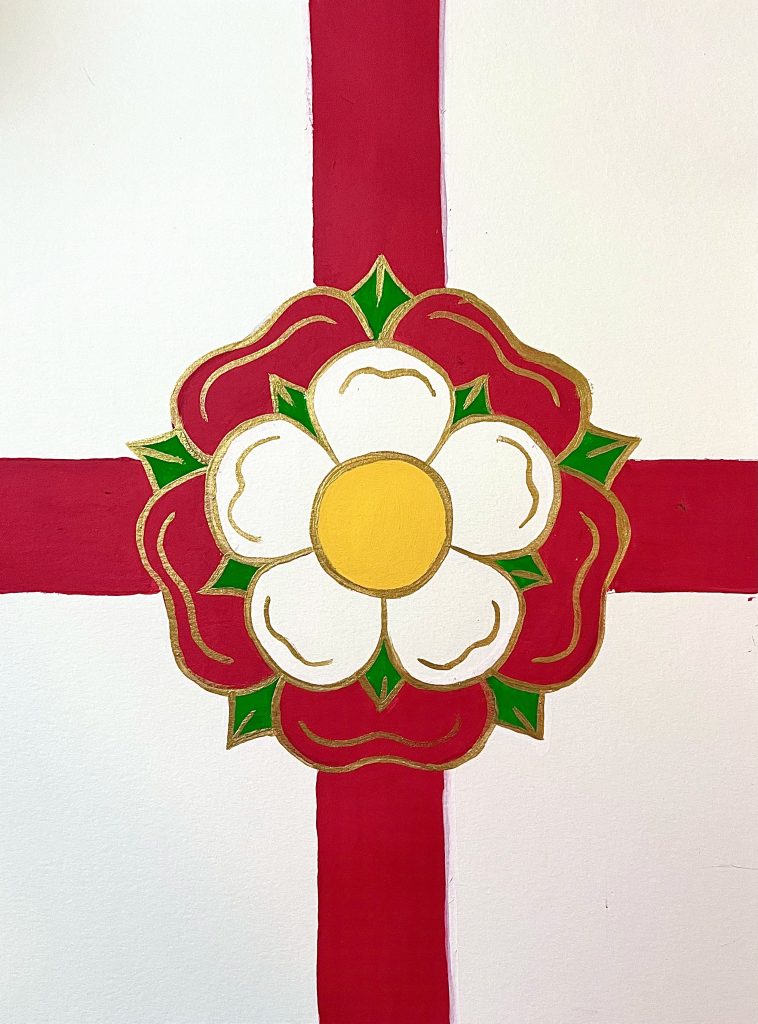
Tudor Rose Art Lesson
The Tudor Rose is a very famous symbol of England. In the late 1400s, two powerful families were at war over who should rule: the House of Lancaster, whose symbol was the red rose, and the House of York, whose symbol was the white rose.
In 1485, at the Battle of Bosworth, Henry Tudor of Lancaster defeated Richard III of York, becoming King Henry VII. To bring peace and unity, Henry married Elizabeth of York, joining the two rival families into one. As a symbol of this union, they combined the red rose and the white rose to become the Tudor Rose, with the red outer petals representing Lancaster, and the inner white petals representing York.
The joining of the two houses, creating the Tudor Rose, symbolized the end of the war and was the beginning of a new royal dynasty. That’s why you’ll see it carved into stonework, embroidered onto clothing, painted in portraits, and used as a royal emblem all throughout Tudor England. In this art lesson, we will paint the Tudor Rose in acrylics.
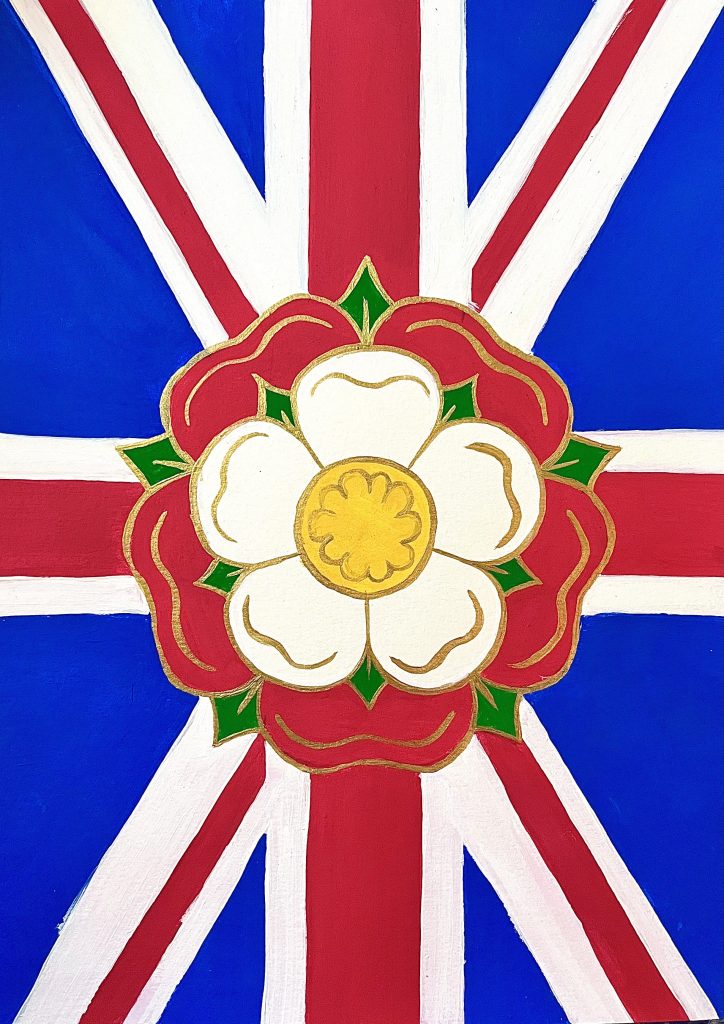
You will need:
- 9×12 watercolor paper
- Acrylic paints (red, white, yellow, green, blue, and metallic gold)
- Paint brush
- Ruler
Solfa
Charlotte Mason incorporated solfa lessons twice a week for about 10 minutes each. These lessons are intended to be repeated and you can stay on any lesson for as long as you like. Here is the YouTube channel Lara and her boys enjoy and recommends for practicing solfa, Children of the Open Air:
Brush Drawing
Brush drawing builds motor and observation skills. We have included a link to videos by Bestowing the Brush below which are great for all ages to learn together:
