
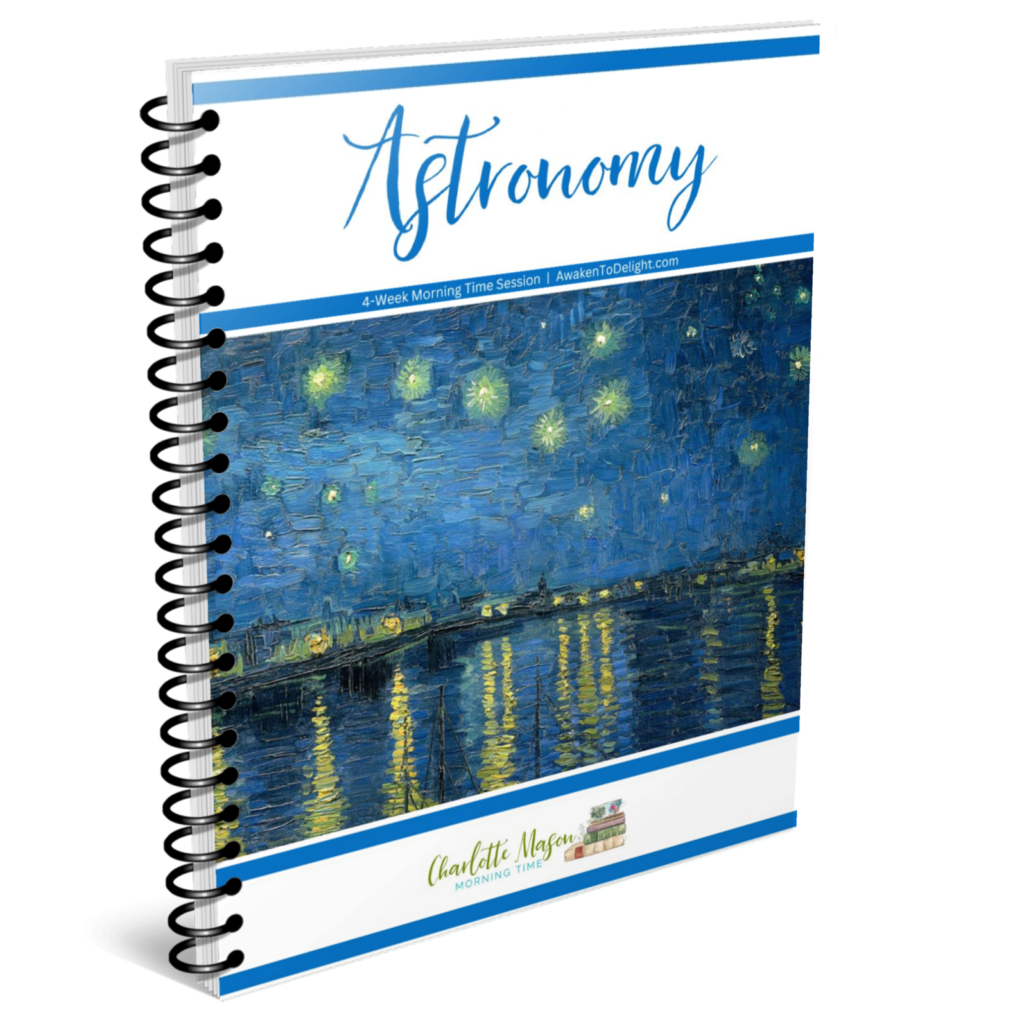
Welcome to the Astronomy Morning Time Session!
Click on the button above to download the entire PDF,
or download only the sections you want below.
Schedule
Recommended Books
Prayer & Scripture Memorization
As parents, we have an immense responsibility to train our children in the Word of God. They must be taught all of the powerful truths contained within it. This is not my suggestion; it is the
commandment of the Lord:
Deuteronomy 6:6-7 (AMPC) says, “And these words which I am commanding you this day shall be first in your own minds and hearts; then you shall whet and sharpen them so as to make them penetrate, and teach and impress them diligently upon the minds and hearts of your children… “
Colossians 3:16 says, “Let the word of Christ dwell in you richly in all wisdom…” And Psalm 119:11 says, “Your word I have hidden in my heart, that I might not sin against You.”
There are many, many more scriptures that command us and show us the benefits of putting the Word of God in our hearts on a regular basis. So in all of the memorization that we have our children and teens do, Bible verses and passages are the most important. For this reason, we include copywork for scripture memorization in our sessions.
This session, we will learn Psalm 19 and focus on writing and memorizing the Psalm 8.
Artist Study
This session’s featured artist is Vincent van Gogh. We’ve included four art selections for your kids and teens to use for picture study. They are:
- The Starry Night
- Starry Night Over the Rhône
- Wheat Field with Cypresses
- Still Life: Vase with Fourteen Sunflowers
Composer Study
Our featured composer is Gustav Holst. We’ve included four of his pieces (with links to each) to listen to. They are:
- Jupiter
- Venus
- Mars
- Neptune
Listen to each piece below:
Jupiter
Venus
Mars
Neptune
Hymn/Folk Song
Hymn
The hymn for this session is, “How Great Thou Art.” It was was based on a Swedish poem written by Carl Boberg in 1885.
Boberg wrote the poem while walking home from church one evening in Mönsterås, Sweden, when he was inspired by the sight of the beautiful countryside and the sound of the wind and waves.
The original version of the hymn was titled “O Store Gud” (O Great God) and was published in the first edition of Boberg’s book Songs by the Way in 1886, which was a collection of nine religious songs Boberg had composed. The lyrics, literally translated to English, said:
When I the world consider
Which Thou has made by Thine almighty Word
And how the webb of life Thou wisdom guideth
And all creation feedeth at Thy board.
Then doth my soul burst forth in song of praise
Oh, great God, Oh, great God!
The poem was first translated into English in 1911 by Stuart K. Hine, and published in a collection of his own songs called My Songs to Jesus. However, the most common English version of the hymn is based on a translation by English missionary George Beverly Shea. Shea’s version was first published in 1955 in a collection of his own songs called Southland Songs.
How Great Thou Art has been recorded by many artists and is a popular choice for funerals and other religious occasions. The hymn was inducted into the Grammy Hall of Fame in 2004 and was ranked number one on a list of the top 50 Catholic songs of all time by the Catholic News Service in 2013.
The hymn is a reminder of the greatness and glory of God, as the lyrics focus on God’s greatness and majesty, and express awe at His creation. The hymn reminds us that despite the trials and tribulations of life, God is always there for us. It is an expression of hope and faith in the midst of difficult times and is a beautiful hymn that has brought comfort and hope to many people over the years.
Listen to the music and sing along with it below:
Folk Song
“I Know Starlight, I Know Moonlight” originated as an African-American spiritual during the era of slavery. It has been sung in South Georgia as a funeral song for sailors for many years. Below is an excerpt from a historical record book that has a few more details about the origins of the beautiful, haunting song.
The following text is from Slave Songs of the United States, by William Francis Allen, Charles Pickard Ware, and Lucy McKim Garrison, xliv, 115 p. New York, A. Simpson & Co. 1867
(The full book may be found here: https://docsouth.unc.edu/church/allen/allen.html)
[This is probably the song heard by W. H. Russell, of the London Times, as described in chapter xviii. of “My Diary North and South.” The writer was on his way from Pocotaligo to Mr. Trescot’s estate on Barnwell Island, and of the midnight row thither he says:
“The oarsmen, as they bent to their task, beguiled the way by singing in unison a real negro melody, which was unlike the works of the Ethiopian Serenaders as any- thing in song could be unlike another. It was a barbaric sort of madrigal, in which one singer beginning was followed by the others in unison, repeating the refrain in chorus, and full of quaint expression and melancholy.
And then some appeal to the difficulty of passing the ‘Jawdam’ constituted the whole of the song, which continued with unabated energy during the whole of the little voyage. To me it was a strange scene. The stream, dark as Lethe, flowing between the silent, houseless, rugged banks, lighted up near the landing by the fire in the woods, which reddened the sky–the wild strain, and the unearthly adjurations to the singers’ souls, as though they were palpable, put me in mind of the fancied voyage across the Styx.”
We append with some hesitation the following as a variation; the words of which we borrow from Col. Higginson. Lt. Col Trowbridge says of it that it was sung at funerals in the night time—one of the most solemn and characteristic of the customs of the negroes. He attributes its origin to St. Simon’s Island, Georgia.
“‘I’ll lie in de grave and stretch out my arms,’ Never, it seems to me, since man first lived and suffered, was his infinite longing for peace uttered more plaintively than in that line.” — Col. Higginson.]
Listen and sing along with it below:
Poetry
This session’s featured poet is William Wordsworth. We’ve included four poetry selections for your kids and teens to read, listen to, memorize, and recite. They are:
- The Stars Are Mansions Built By Nature’s Hand
- Who But Is Pleased To Watch The Moon On High
- The Crescent-Moon, The Star of Love
- To the Moon – Rydal
For copywork, we have included Zaner-Bloser style handwriting sheets for primary, elementary, and cursive, as well as college ruled for older students. The poems we have chosen are:
- The Stars Are Mansions Built By Nature’s Hand
- Who But Is Pleased To Watch The Moon On High
- The Crescent-Moon, The Star of Love
Copywork
Tea Times
In this session we have two recipes: Moon Phase Oreos and Galaxy Popcorn!
We will also have two Mythology teas, a Folk Tale tea, and a Fable teatime:
Mythology Teatime: A Wonder Book, “The Three Golden Apples” by Nathaniel Hawthorne
Mythology Teatime: Wonder Stories “How Orion Found His Sight” by Carolyn Sherwin Bailey
Folktale Teatime: The Star Talers, a German Folktale
Fable Teatime: Aesop’s Fables, “The Astrologer”
Shakespeare
For our Shakespeare selection, we have chosen the Bard’s comedy, “Twelfth Night.” Read it from E. Nesbit’s Beautiful Stories from Shakespeare in the following pages. But we also recommend reading the actual play together as a family if you can.
Your older kids and teens may enjoy watching a movie adaptation (please pre-screen these first). And if you can take in a live performance, your family will never forget it!
We are including a link on our website to watch a pre-recorded stage performance of “Twelfth Night” by Texas Shakespeare Festival.
Watch a performance of Twelfth Night by The Texas Shakespeare Festival below:
Nature Study
Each Friday morning, you will go through two of our nature cards. They are labeled in the upper right corner with the corresponding week. These are short, factual cards with images to help your child become familiar with objects in the natural world.
As you progress through our sessions, you may find it handy to keep your past nature cards in a binder for easy reference when your children come across a familiar object. These seeds you are planting will grow into a wonderful garden of knowledge for your children in years to come.
As you explore nature outside your home, watch and listen for newly discovered delights.
Handicraft
For our handicraft lesson, we will be creating a galaxy globe. This is a simple activity that all ages can enjoy. (Though younger children will need a bit of help with the liquids and glitter measurements.)
Using food coloring, cotton balls, and a fair amount of glitter, you will create a globe to simulate a celestial sphere with a cloudy nebula contained inside.
Art Lesson
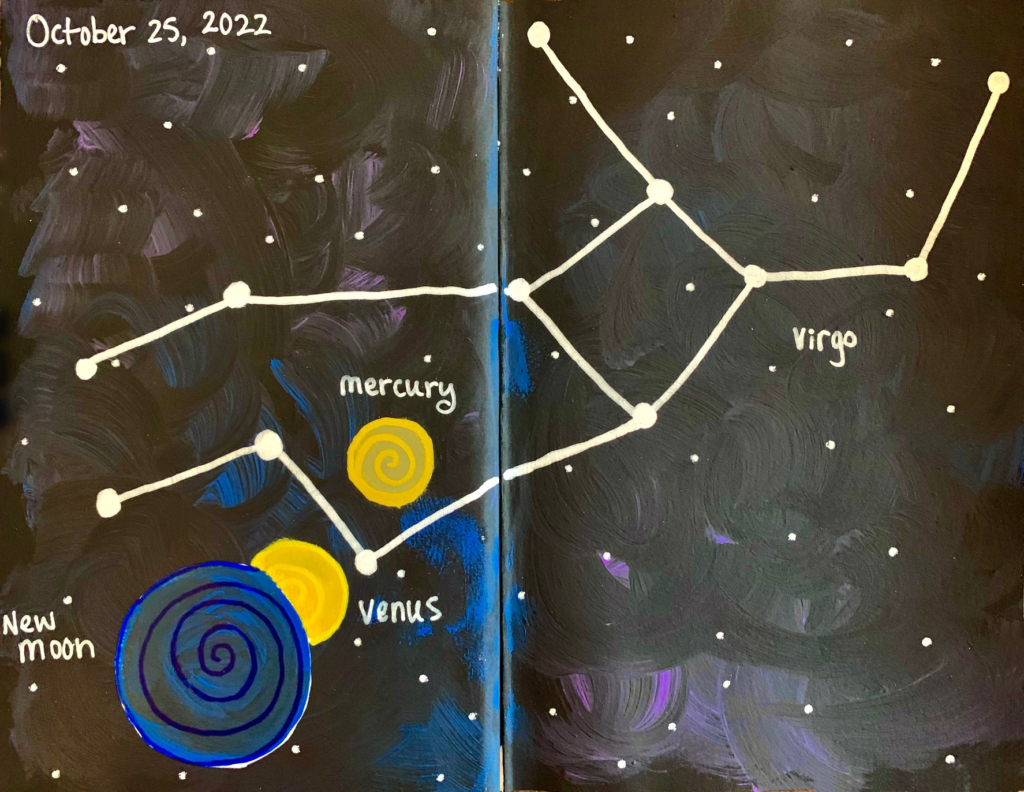
In this lesson, we create a “star map” of the night sky. An option is to use an art journal and add to it year round as a way to document the phases of the moon and rotation of the stars and planets.
Supplies needed:
- Mixed media paper or art journal
- Acrylic paints (black, blue, purple, and white)
- Paint brushes
- White Sharpie or gel pen
- Optional: colorful markers or paint pens
History & Geography
For our History reading, we are linking to Great Astronomers, by Sir Robert S Ball, originally published in 1895. Within, he gives short biographies of 18 astronomers beginning with Ptolemy through John Couch Adams. So, some well known and some lesser known.
Please be aware that the author writes from the assumption that evolution is a correct and sound theory. You may want to discuss this with your children before reading through it.
Solfa
Charlotte Mason incorporated solfa lessons twice a week for about 10 minutes each. These lessons are intended to be repeated and you can stay on any lesson for as long as you like. Here is the YouTube channel Lara and her boys enjoy and recommends for practicing solfa, Children of the Open Air:
Brush Drawing
Brush drawing builds motor and observation skills. We have included a link to videos by Bestowing the Brush below which are great for all ages to learn together:
