
Welcome to the Age of Enlightenment Morning Time Session!
Click on the button above to download the entire PDF,
or download only the sections you want below.
Schedule
Recommended Books
Prayer & Scripture Memorization
For Bible reading, we will make suggestions for your morning time reading. However, if you’d prefer a more in-depth schedule, we recommend checking out various plans that will help you read the Bible through.
For a one-year plan, we recommend YouVersion’s One Year Bible: https://www.bible.com/readingplans/60. You can also listen to it being read aloud on the app.
Download a two-year reading plan from the Gospel Coalition here:
https://media.thegospelcoalition.org/static-blogs/tgc/files/2010/12/TGC-Two-Year-Bible-ReadingPlan1.pdf
If you prefer to go even slower, Ambleside Online offers three, four, and five-year Bible reading
plans: https://www.amblesideonline.org/L/Lbiblesch.html
This session, we will learn the Great God, with Wonder and Praise prayer, and focus on writing and memorizing James 1:2-8.
Artist Study
This session’s featured artist is Jacques-Louis David. We’ve included six art selections for your kids and teens to use for picture study. They are:
- Oath of the Horatii, 1784
- The Death of Socrates, 1787
- Portrait of Anne-Marie-Louise Thélusson, Comtesse de Sorcy, 1790
- The Death of Marat, 1793
- Napoleon Crossing the Alps at the Sainte-Bernard Pass, 1801
- The Coronation of Napoleon, 1807
Composer Study
This session’s featured composer is Wolfgang Amadeus Mozart. We have included six of his pieces for music study. They are:
- Eine kleine Nachtmusik, Serenade No. 13
- Piano Sonata No. 11 in A major, K. 331
- Clarinet Concerto in A major, K.622
- Symphony No. 40 in G minor
- Piano Concerto No. 21. K.467
- Requiem in D minor
Plus a fun bonus:
- The Magic Flute (Opera)
Listen to each piece below:
Eine kleine Nachtmusik, Serenade No. 13
Piano Sonata No. 11 in A major, K. 331
Clarinet Concerto in A major, K.622
Symphony No. 40 in G minor
Piano Concerto No. 21. K.467
Requiem in D minor
BONUS: The Magic Flute (Opera)
BONUS: Mozart’s Magic Fantasy
Hymn/Folk Song
Hymn
“Come, Thou Fount of Every Blessing” was written in 1757 by Robert Robinson, a young pastor in England who composed the hymn at just 22 years old. The lyrics speak of God as a source of blessing and guidance. Musically, the hymn is most commonly sung today to the tune “Nettleton,” an American folk song from the early 19th century. The pairing of Robinson’s words with this melody helped the hymn gain widespread popularity, particularly in the United States. Over time, it became a staple in many Protestant traditions and continues to be sung in churches, homes, and gatherings around the world.
Listen to the music and sing along with it below:
Come, Thou Fount of Every Blessing
Folk Song
“The Oak and the Ash” is a traditional English folk song that reflects both the natural landscape of England and the deep emotional ties people have to place, identity, and home. Its lyrics center on the oak, the ash, and the bonny ivy tree—three plants that were quite familiar to people living in the English countryside. These trees and plants carried symbolic meaning. The oak often represented strength and endurance, the ash was associated with everyday usefulness and rural life, and the ivy symbolized faithfulness and enduring attachment. “The Oak and the Ash” offers a glimpse into a way of life where nature, memory, and identity were closely intertwined, and it remains a gentle reminder of the enduring human desire to belong to a place and to remember where one comes from.
Listen and sing along with it below:
The Oak and the Ash
Poetry
Our featured poet for this session is Johann Wolfgang Goethe, a polymath who lived throughout the late Enlightenment era into the Romanticism movement. We’ve included six poetry selections for your kids and teens to read, listen to, memorize, and recite. They are:
- Rosebud in the Heather
- Found
- Wanderer’s Night Song
- May Song
- Autumn Feelings
- The Sorcerer’s Apprentice
For copywork, we have included Zaner-Bloser style handwriting sheets for primary, elementary, and cursive, as well as college ruled for older students. We have chosen three poems, as well as a historical speech to copy, listed below:
- Found
- Wanderer’s Night Song
- May Song
- Autumn Feelings
Bonus:
Although our featured composer for this session is Mozart, we thought it would be fun for your family to listen to some of Goethe’s poems set to music—primarily as Lieder, or “art songs” by other great composers:
- Click here to listen to Rosebud in the Heather/Heidenröslein, by Franz Schubert.
- Click here to listen to Wanderer’s Night Song/Über allen Gipfeln, by Franz Schubert.
- Click here to listen to May Song/Mailied, by Ludwig van Beethoven.
- Click here to listen to The Sorcerer’s Apprentice /Der Zauberlehrling, by Paul Dukas.
Copywork
Tea Times
In this session, we are giving you six Age of Enlightenment recipes for our tea time: American Independence Day Cake, Orsaderolletjes (Dutch Almond Cookies), English Mini Lemon Cheesecakes, French Meringues, Mandel-Kränzlein (German Almond Wreaths), and Scottish Bannocks.
We will also have six storytime teas:
Historical Tea 1: Excerpt from Common Sense, by Thomas Paine
Storytime Tea 2: Excerpt from The Life and Perambulations of a Mouse, by Dorothy Kilner
Storytime Tea 3: Pride and Prejudice, Ch. VIII, by Jane Austen
Fable Tea 4: La Fontaine’s Fables, “The Lion and the Gnat,” by Jean de La Fontaine
Fairy Tale Tea 5: Grimm’s Fairy Tales, “Little Red Cap,” by the Brothers Grimm
Storytime Tea 6: The Renowned History of Goody Two-Shoes, Ch. 1-4, by Anonymous
Plutarch
For our Plutarch selection, we have chosen the chapter “Tully,” a study of Cicero from The Children’s Plutarch: Stories of the Romans, and included it on the following pages. The book may also be purchased on Amazon.
If your children are 6th grade or older, we recommend spending a full 12-week term studying Pericles with the edited (for length and content) study guide from Ambleside below.
You can also purchase the guide by Anne White on Amazon. (This is in place of The Children’s Plutarch, not in addition to.)
Nature Study
Each Friday morning, you will go through two of our nature cards. They are labeled in the upper right corner with the corresponding week. These are short, factual cards with images to help your child become familiar with objects in the natural world.
As you progress through our sessions, you may find it handy to keep your past nature cards in a binder for easy reference when your children come across a familiar object. These seeds you are planting will grow into a wonderful garden of knowledge for your children in years to come.
As you explore nature outside your home, watch and listen for newly discovered delights.
Handicraft
For our handicraft lesson, we will create a simple quilling piece using thin strips of paper. Quilling kits are inexpensive, however, if you have a paper cutter, you may prefer to cut your own strips rather than purchasing pre-cut paper. If you choose to do so, we recommend using a heavier weight of paper (28-32 lb.), and cutting the strips to either ⅛ inch (3mm) or ¼ inch (5mm) wide. This craft is both relaxing and rewarding, making it a wonderful way for students to develop patience, fine motor skills, and an appreciation for detailed handiwork.
We have included a “Quilling Shape Chart” if your students want to create their own designs. For more kid-friendly designs, check out Red Ted Art. If your teens prefer more intricate designs, check out The Papery Craftery.
Art Lesson
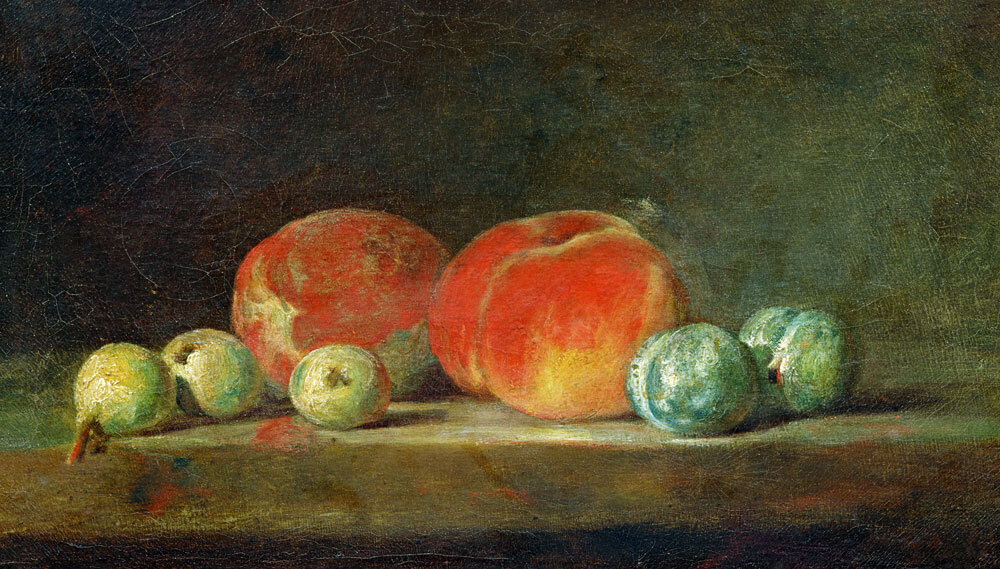
In this lesson, we will recreate the still life, Peaches, Pears and Plums by Jean Siméon Chardin. This is a long lesson, but not a difficult one. You may want to split it up into separate days, especially for younger children. Let them watch the video all the way through to see the process is simply adding mid-tone colors, highlights, and shadows to give each piece of fruit a three-dimensional shape. Then, if they so desire, they can arrange their own fruit to paint a still life from real life.
Supplies needed:
- 5×9 piece of watercolor paper
- Acrylic paints (dark brown, light brown, dark green, yellow, red, white)
- Flat and round brushes
- Water, paper towel and paper plate
History & Geography
In this session, we have included mini biographies of twelve key thinkers of the Age of Enlightenment.
For history, your students will read chapters 44-55 of The Story of Mankind (TSOM). This book is linked for free on our site. For a well-rounded overview of the Enlightenment, we also recommend George Washington’s World, by Genevieve Foster. Here is a free version, and here is a link to Amazon to purchase your own copy.
For geography, we have also included two maps for you to study and use for map drills: “Europe, 1700s” and “The Thirteen Colonies, 1775” (This map is provided by TheCollector.com).
Solfa
Charlotte Mason incorporated solfa lessons twice a week for about 10 minutes each. These lessons are intended to be repeated, and you can stay on any lesson for as long as you like. Here is the YouTube channel Lara and her boys enjoy and recommend for practicing solfa, Children of the Open Air:
Brush Drawing
Brush drawing builds motor and observation skills. We have included a link to videos by Bestowing the Brush below which are great for all ages to learn together:
