
Welcome to the Wildflowers Morning Time Session!
Click on the button above to download the entire PDF,
or download only the sections you want below.
Schedule
Recommended Books
Prayer & Scripture Memorization
For Bible reading, we will make suggestions for your morning time reading. However, if you’d prefer a more in depth schedule, we recommend checking out various plans that will help you read the Bible through.
For a one-year plan, we recommend YouVersion’s One Year Bible: https://www.bible.com/readingplans/60. You can also listen to it being read aloud on the app.
Download a two-year reading plan from the Gospel Coalition here:
https://media.thegospelcoalition.org/static-blogs/tgc/files/2010/12/TGC-Two-Year-Bible-ReadingPlan1.pdf
If you prefer to go even slower, Ambleside Online offers three, four, and five-year Bible reading
plans: https://www.amblesideonline.org/L/Lbiblesch.html
This session, we will learn Morning Bright and focus on writing and memorizing Matthew 6:25-29.
Artist Study
This session’s featured artist is Mary Vaux Walcott. We’ve included four art selections for your kids and teens to use for picture study. They are:
- Balsamroot (Balsamorhiza sagittata)
- Eustoma russelianum
- Common Pitcherplant (Sarracenia purpurea venosa)
- California Rose-Bay (Rhododendron californicum)
Composer Study
Instead of a featured composer, we have included four wildflower-themed pieces from various composers, as well as a bonus opera, (with links to each) to listen to. They are:
- Symphony No. 3, 2nd Movement: What the Wildflowers in the Meadow Tell Me
- Waltz of the Flowers
- Crisantemi (Chrysanthemums)
- Bruyères (Heather) Prelude
- BONUS OPERA: Duo des fleurs (Flower Duet)
Listen to each piece below:
Symphony No. 3, 2nd Movement: What the Wildflowers in the Meadow Tell Me
Waltz of the Flowers
Crisantemi (Chrysanthemums)
Bruyères (Heather) Prelude
BONUS OPERA: Duo des fleurs (Flower Duet)
Hymn/Folk Song
Hymn
“Joyful, Joyful, We Adore Thee” was written by a man named Henry van Dyke, who was an American author and clergyman who lived in the 20th century. He wrote the hymn in 1907 as a poem titled “Hymn of Joy,” which would later become popularly known by its contemporary name based upon the first lyric of the song. He was inspired by the beauty of the mountains surrounding him on one of his travels and wanted to express his feelings of gratitude and praise to God through his poetry.
The melody that accompanies the lyrics of “Joyful, Joyful, We Adore Thee” was composed by Ludwig van Beethoven, a famous German composer. Beethoven originally wrote this melody as the final movement of his Symphony No. 9, also known as the “Choral Symphony.” This symphony is one of Beethoven’s most famous works and is celebrated for its uplifting and triumphant spirit.
When Henry van Dyke wrote the hymn, he was insistent that the words be set to this work of Beethoven’s for its jubilant nature.
The melody perfectly complements van Dyke’s words, creating a sense of exuberance and praise. When sung together, the combination of the joyful lyrics and the stirring melody inspires worshippers to lift their voices in praise and thanksgiving.
Listen to the music and sing along with it below:
Folk Song
“Lavender’s Blue” is a timeless folk song that has been sung by generations of people across the world. Its origins are somewhat mysterious, as it has been passed down through oral tradition, meaning it was largely sung and shared by word of mouth rather than being written down. The song’s earliest known published version dates back to the late 17th century in England, though
it is likely to have existed before then in oral tradition. Back then, it was known as “Diddle, Diddle, or the Kind Country Lovers.” The lyrics were a bit different from what we know today, but it took root and began to spread.
Over time, the song evolved as it was sung by different people in different places. The present-day lyrics of “Lavender’s Blue” tell a simple yet charming story of love and courtship. The protagonist, often portrayed as a young maid or shepherdess, is wooed by her suitor with promises of a life filled with happiness and joy. The repeated refrain, “Lavender’s blue, dilly dilly, lavender’s green,” adds a whimsical touch to the song, evoking images of fragrant gardens and colorful blooms. The simple beauty of the tune and its accompanying words have led it to be a beloved classic.
Listen and sing along with it below:
Poetry
Instead of a featured poet, we have selected poetry that features wildflowers from several different writers. We’ve included four poetry selections for your kids and teens to read, listen to, memorize, and recite. They are:
- A Very Wild Flower, by Mildred Howells
- Maker of Heaven and Earth, by Cecil Frances Alexander
- The Flower, by Alfred Lord Tennyson
- The Wild Flower’s Song, by William Blake
For copywork, we have included Zaner-Bloser style handwriting sheets for primary, elementary, and cursive, as well as college ruled for older students. The poems we have chosen are:
- A Very Wild Flower, by Mildred Howells
- Maker of Heaven and Earth, by Cecil Frances Alexander
- The Flower, by Alfred Lord Tennyson
- The Wild Flower’s Song, by William Blake
Copywork
Tea Times
In this session we are giving you four recipes for our hospitality tea: Glazed Lemon Lavender Scones, Edible Flower Cookies, Viola
Tea Sandwiches, and Flower Garden Fruit Cups, with bonus floral tea ideas!
We will also have three Storytime teas and a Fairy Tale Tea:
Storytime Tea 1: Through the Looking Glass, Chapter II: “The Garden of Live Flowers” by Lewis Carroll
Storytime Tea 2: Anne of Green Gables, Chapter XX: “A Good Imagination Gone Wrong” by L.M. Montgomery
Storytime Tea 3: Heidi, Chapter III: “Little Bear and Little Swan” by Johanna Spyri
Fairy Tale Tea: The Yellow Fairy Book, “The Flower Queen’s Daughter” by Andrew Lang
Shakespeare
For our Shakespeare selection, we have chosen “A Midsummer Night’s Dream.”
Read it from Beautiful Stories from Shakespeare by E. Nesbit in the following pages.
But we also recommend reading the actual play together as a family if you can.
Your older kids and teens may enjoy watching a movie adaptation (please pre-screen these first). And if you can take in a live performance, your family will never forget it!
We are including a link below to watch a pre-recorded stage performance of “A Midsummer Night’s Dream.”
Watch a performance of “Midsummer Night’s Dream” by The Palm Beach Shakespeare Festival below:
Nature Study
Each Friday morning, you will go through two of our nature cards. They are labeled in the upper right corner with the corresponding week. These are short, factual cards with images to help your child become familiar with objects in the natural world.
As you progress through our sessions, you may find it handy to keep your past nature cards in a binder for easy reference when your children come across a familiar object. These seeds you are planting will grow into a wonderful garden of knowledge for your children in years to come.
As you explore nature outside your home, watch and listen for newly discovered delights.
Handicraft
For our handicraft lesson, we will create a flower press and a pressed flower bookmark. Look for flowers on a sunny afternoon when the dew has evaporated completely. Choose full flowers that have smaller flat heads or larger multi-petal blooms so that you can press the individual petals. Press your flowers in either a book or flower press, and leave them alone for 7 to 10 days. When you check them, make sure they are completely dry and papery. Only then will they be ready to use for crafting.
Art Lesson
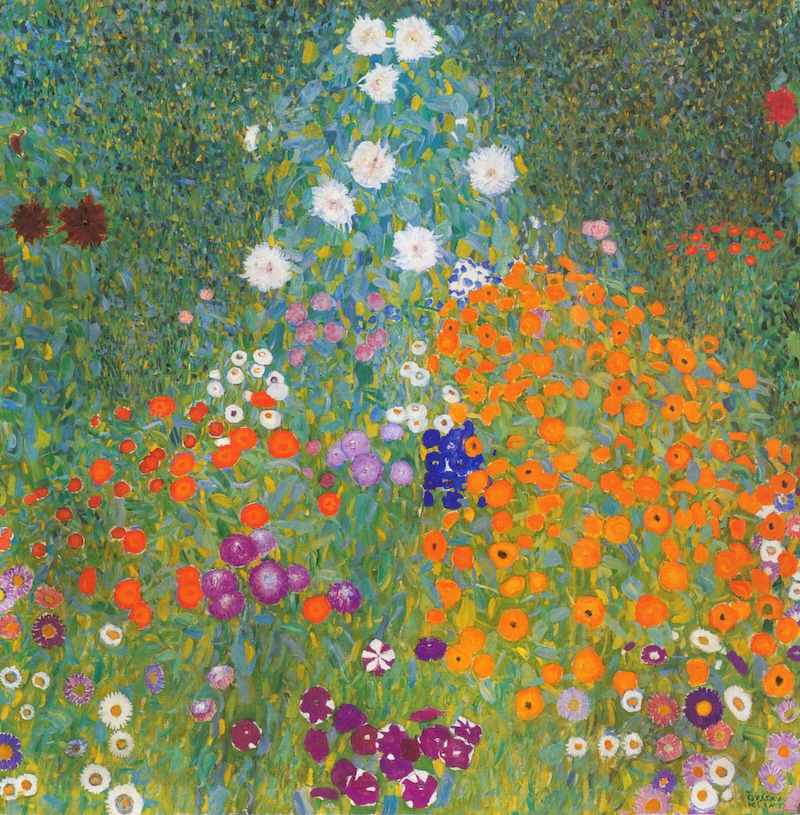
In this lesson, we are going to create an messy, crazy, and FUN piece inspired by Gustav Klimt’s piece, Bauerngarten (or Farm Garden). I highly recommend creating this piece outside or by using a cardboard box for the “splatter paint” process.
Supplies needed:
- Watercolor paper (9×12, cut to a 9-inch square)
- Acrylic paints (greens, blues, yellow, orange, red, purple, and white)
- Paint brushes (medium or small round)
- Cardboard box (optional)
- Spray water bottle
- Paper plates (1 each for the splatter paint section), plus 1 for the rest of the paints, paper towels, jar of water
History & Geography
There are no History or Geography selections for this session.
Solfa
Charlotte Mason incorporated solfa lessons twice a week for about 10 minutes each. These lessons are intended to be repeated and you can stay on any lesson for as long as you like. Here is the YouTube channel Lara and her boys enjoy and recommends for practicing solfa, Children of the Open Air:
Brush Drawing
Brush drawing builds motor and observation skills. We have included a link to videos by Bestowing the Brush below which are great for all ages to learn together:
