
Welcome to the Classical History Morning Time Session!
Click on the button above to download the entire PDF,
or download only the sections you want below.
Schedule
Recommended Books
Prayer & Scripture Memorization
For Bible reading, we will make suggestions for your morning time reading. However, if you’d prefer a more in depth schedule, we recommend checking out various plans that will help you read the Bible through.
For a one-year plan, we recommend YouVersion’s One Year Bible: https://www.bible.com/readingplans/60. You can also listen to it being read aloud on the app.
Download a two-year reading plan from the Gospel Coalition here:
https://media.thegospelcoalition.org/static-blogs/tgc/files/2010/12/TGC-Two-Year-Bible-ReadingPlan1.pdf
If you prefer to go even slower, Ambleside Online offers three, four, and five-year Bible reading
plans: https://www.amblesideonline.org/L/Lbiblesch.html
This session, we will learn 1 Corinthians 1:4-9 and focus on writing and memorizing 1 Corinthians 13:4-8.
Artist Study
This session’s featured artist is Angelica Kauffman. Additionally, we have included a study on Greek art and architecture for your family to enjoy as well! We’ve included six art selections for your kids and teens to use for picture study. They are:
- Cornelia, Mother of the Gracchi
- The Sorrow of Telemachus
- Telemachus and the Nymphs of Calypso
- Bacchus and Ariadne
- Hector Upbraiding Paris for his Retreat from Battle
- Papirius Praetextatus Entreated by his Mother
Composer Study
While this session features a musician, he is not the focus of this Composer Study. The first three pieces are interpretations from four surviving works by Mesomedes of Crete circa 130 A.D. The fourth, fifth, and sixth pieces were composed by Michael Levy, a modern musician who reconstructed and regularly performs with ancient Greek and Roman instruments such as the lyre and the kithara. They are:
- Hymn to the Muse
- Hymn to the Sun
- Hymn to Nemesis
- The Temple of Jupiter
- In an Ancient Roman Garden
- The Temple of Venus
Listen to each piece below:
Hymn to the Muse – Mesomedes of Crete
Hymn to the Sun – Mesomedes of Crete
Hymn to Nemesis – Mesomedes of Crete
The Temple of Jupiter – Michael Levy
In an Ancient Roman Garden – Michael Levy
The Temple of Venus – Michael Levy
Hymn/Folk Song
Hymn
The hymn “Holy, Holy, Holy, Lord God Almighty” has stood the test of time as a powerful expression of worship and praise in the Christian tradition. Composed by Reginald Heber in the early 19th century, this hymn has become a beloved part of religious services around the world.
Heber was inspired by the biblical passage from the book of Revelation, which describes heavenly beings singing praises to God, saying, “Holy, holy, holy is the Lord God Almighty, who was and is and is to come” (Revelation 4:8).
Over the years, “Holy, Holy, Holy” has become a staple in Christian worship services, used in various denominations and settings. The hymn invites believers to join in the heavenly chorus, acknowledging and celebrating the holiness of God.
Listen to the music and sing along with it below:
Holy, Holy, Holy, Lord God Almighty – the Brooklyn Tabernacle Choir.
Folk Song
“The Roman Centurion’s Song (Roman Occupation of Britain, A.D. 300),” is a poem written in 1885 by Rudyard Kipling. It first appeared in the textbook A School History of England, which was written for boys and girls in 1911 by C.R.L. Fletcher and had 23 poems by Kipling included within.
The poem portrays the heartfelt plea of a Roman centurion who faces orders to depart from Britain after forty years of service. The centurion, deeply rooted in the land he has served in for decades, expresses his profound connection and attachment to Britain, emphasizing that this land has become his true home.
The poem was set to music in 1989 by Peter Bellamy and is not in the public domain. Therefore, we can not provide a copy of the music. However, we have provided links below to listen to both the poem read aloud and the poem set to music!
Listen and sing along with it below:
The Roman Centurion’s Song – Leslie Fish and Joe Bethancourt
The Roman Centurion’s Song – Rudyard Kipling
Poetry
Instead of a featured poet for this session, we have picked poems from various writers that represent the wonders of Ancient Greece and Rome. We’ve included six poetry selections for your kids and teens to read, listen to, memorize, and recite. They are:
- Ulysses (by Lord Tennyson)
- The Lotos-eaters (by Lord Tennyson)
- Ode on a Grecian Urn (by Keats)
- A Portion of “Excursion” (by Wordsworth)
- A Song of Proserpine (by Shelley)
- Prometheus (by Lord Byron)
For copywork, we have included Zaner-Bloser style handwriting sheets for primary, elementary, and cursive, as well as college ruled for older students. The poems we chose are:
- Ode on a Grecian Urn
- A Portion of “Excursion”
- Ulysses
- A Portion of “The Lotos-eaters”
Copywork
Tea Times
In this session, we are giving you six recipes for our hospitality tea: Ancient Roman Cake, Greek Honey Cake, Maritozzi, Savillum, Greek Pancakes, and Patina de Piris (Pear Soufflé).
We will also have five Mythology Teas and one Fable Tea:
Mythology Tea 1: Bulfinch’s Mythology: The Age of Fable, “The Trojan War,” by Thomas Bulfinch
Mythology Tea 2: Bulfinch’s Mythology: The Age of Fable, ”The Iliad,” by Thomas Bulfinch
Mythology Tea 3: Tanglewood Tales, “The Golden Fleece,” by Nathaniel Hawthorne
Mythology Tea 4: How Rome Was Founded, by James Baldwin
Mythology Tea 5: A Book of Myths, “Perseus the Hero,” by Jean Lang
Fable Tea 6: Aesop’s Fables, “The Peacock and Juno,” by Aesop
Plutarch
For our Plutarch selection, we have chosen the chapter “The Conqueror,” a study of Alexander the Great from The Children’s Plutarch: Stories of the Greeks, and included it on the following pages. The book may also be purchased on Amazon.
If your children are 6th grade or older, we recommend spending a full 12-week term studying Alexander the Great with the edited (for length and content) study guide from Ambleside here:
https://amblesideonline.org/plutarch-alexander1
You can also purchase the guide by Anne White on Amazon. (This is in place of The Children’s Plutarch, not in addition to.)
Nature Study
Each Friday morning, you will go through two of our nature cards. They are labeled in the upper right corner with the corresponding week. These are short, factual cards with images to help your child become familiar with objects in the natural world.
As you progress through our sessions, you may find it handy to keep your past nature cards in a binder for easy reference when your children come across a familiar object. These seeds you are planting will grow into a wonderful garden of knowledge for your children in years to come.
As you explore nature outside your home, watch and listen for newly discovered delights.
Handicraft
For our handicraft lesson, we will be creating a Roman-inspired mosaic. We have intentionally kept this lesson simple so that everyone in the family can create together and even experiment with their own designs if desired.
However, feel free to use glass mosaic tiles with grout (and safety goggles) if you want to kick it up a notch.
Furthermore, we recommend the Roman mosaic video lesson (using glass tiles) from the Masterpiece Society’s Art Through the Ages: Classical Art course.
Art Lesson
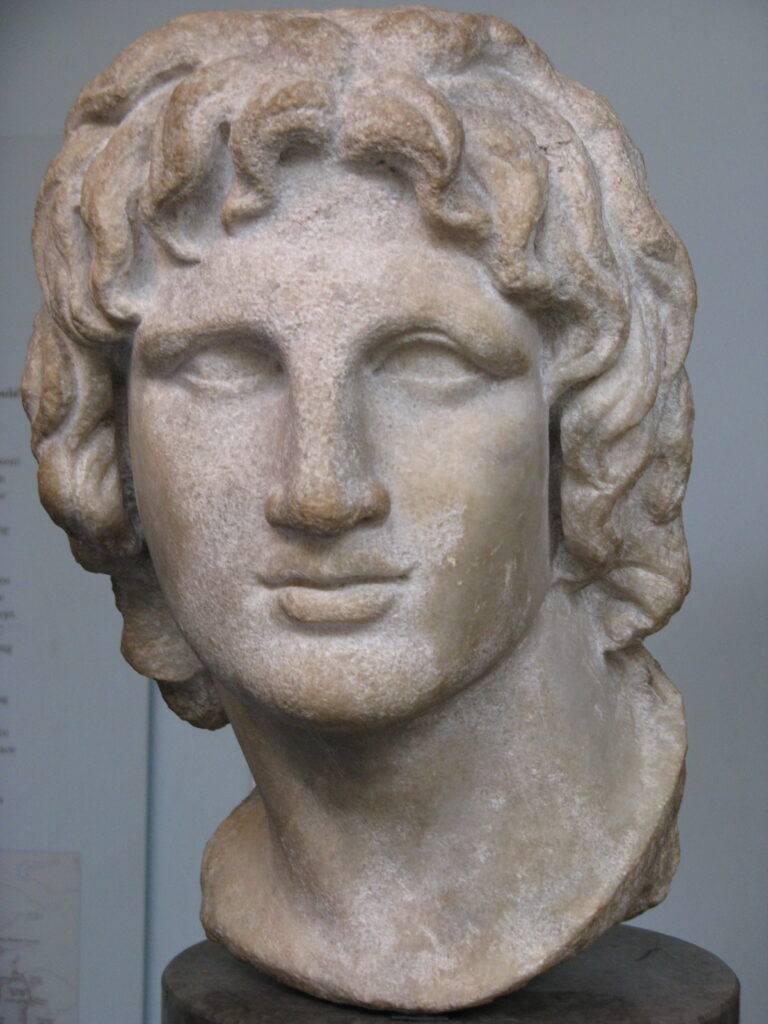
In this lesson, we will recreate the Alexander the Great portrait head (sculpture) from the British Museum using charcoal. The sculpture dates from between 300 BC and 150 BC, and was excavated in Alexandria, Egypt.
Charcoal is an excellent medium to practice shading and adding value to an art piece.
Please Note: This lesson is a bit long (a total of over 1.5 hours in real time), but I have added multiple time-lapsed segments and split the recording into two parts: Part 1 watch time = 30 minutes; Part 2 watch time = 17 minutes.
I would only recommend this lesson for older kids and teens, but would encourage each student to watch the videos all the way through before beginning his or her own piece. For younger students, simply print out the template below and let them paint or color it.
Supplies needed:
- Toned tan paper or brown craft paper
- Charcoal pencils (black and white)
- Blending tools: tortilions, blending stumps, and/or artist chamois
- Kneaded eraser
- Pencil sharpener
This is the Generals charcoal set that I use.
Part One: Applying Shadows with Black Charcoal
Part Two: Applying Highlights with White Charcoal
History & Geography
Solfa
Charlotte Mason incorporated solfa lessons twice a week for about 10 minutes each. These lessons are intended to be repeated and you can stay on any lesson for as long as you like. Here is the YouTube channel Lara and her boys enjoy and recommends for practicing solfa, Children of the Open Air:
Brush Drawing
Brush drawing builds motor and observation skills. We have included a link to videos by Bestowing the Brush below which are great for all ages to learn together:
