
Welcome to the Modern Era Morning Time Session!
Click on the button above to download the entire PDF,
or download only the sections you want below.
Schedule
Recommended Books
Prayer & Scripture Memorization
For Bible reading, we will make suggestions for your morning time reading. However, if you’d prefer a more in depth schedule, we recommend checking out various plans that will help you read the Bible through.
For a one-year plan, we recommend YouVersion’s One Year Bible: https://www.bible.com/readingplans/60. You can also listen to it being read aloud on the app.
Download a two-year reading plan from the Gospel Coalition here:
https://media.thegospelcoalition.org/static-blogs/tgc/files/2010/12/TGC-Two-Year-Bible-ReadingPlan1.pdf
If you prefer to go even slower, Ambleside Online offers three, four, and five-year Bible reading
plans: https://www.amblesideonline.org/L/Lbiblesch.html
This session, we will learn The Sinner’s Prayer and focus on writing and memorizing Romans 9:9-10.
Artist Study
This session’s featured artist is Alma Thomas. We’ve included six art selections for your kids and teens to use for picture study. They are:
- Apollo 12 Splash Down
- Blast Off
- The Eclipse
- Starry Night and the Astronauts
- Snoopy Sees a Sunrise
- Earth Sermon- Beauty, Love and Peace
Composer Study
This session’s featured composer is Leonard Bernstein. We have included six of his pieces for music study. They are:
- Peter Pan (Musical, 1950)
- Serenade after Plato’s Symposium (Orchestral, 1954)
- Symphonic Suite from On the Waterfront (Film Score/Orchestral, 1954)
- Candide Overture (Opera, 1956)
- Symphonic Dances from West Side Story (Musical, 1957; Orchestral 1960)
- Chichester Psalms (Choral, 1967)
Listen to each piece below:
Peter Pan (Musical, 1950)
Serenade after Plato’s Symposium (Orchestral, 1954)
Symphonic Suite from On the Waterfront (Film Score/Orchestral, 1954)
Candide Overture (Opera, 1956)
Symphonic Dances from West Side Story (Musical, 1957; Orchestral 1960)
Chichester Psalms (Choral, 1967)
Hymn/Folk Song
Hymn
“Nothing but the Blood of Jesus” is a timeless American hymn that continues to be sung in many churches throughout the world. It was written by minister and hymnwriter Robert Lowry in 1876, inspired by Hebrews 9:22, “In fact, the law requires that nearly everything be cleansed with blood, and without the shedding of blood there is no forgiveness.” Its lyrics depict Jesus’s blood as the cleanser of believers’ sins and the pathway to righteousness.
Listen to the music and sing along with it below:
Nothing but the Blood of Jesus
Folk Song
Written by American folk singer Woody Guthrie in 1940, “This Land Is Your Land” has become one of the most beloved folk songs in the United States. Set to a simple, familiar melody adapted from an older gospel tune called “When the World’s On Fire,” the song was easy to learn and quickly spread through oral tradition. Its verses paint a vivid picture of the American landscape, from California to New York Island, and examines themes of freedom and equality.
Listen and sing along with it below:
This Land is Your Land
Poetry
Our featured poet for this session is Ogden Nash. We’ve included eight poetry selections for your kids and teens to read, listen to, memorize, and recite. They are:
- The Octopus
- The Ant
- The Fly
- A Flea and a Fly in a Flue
- Further Reflections on Parsley
- Morning Prayer
- The People Upstairs
- The Tale of Custard the Dragon
For copywork, we have included Zaner-Bloser style handwriting sheets for primary, elementary, and cursive, as well as college ruled for older students. We have chosen six poems and two speech excerpts for copywork, listed below:
- The Octopus
- The Ant
- The Fly
- A Flea and a Fly in a Flue
- Morning Prayer
- The People Upstairs
- Excerpt from J.F.K.’s Inaguration Address
- Excerpt from M.L.K. Jr’s “I Have a Dream” Speech
Copywork
Tea Times
In this session, we are giving you six “convenience dessert” recipes from the modern era for your tea time, as well as two bonus recipes. They are: Pineapple Upside Down Cake, Tunnel of Fudge Cake, Strawberry Jello Poke Cake, Ambrosia, Cherry Applesauce Jello Salad, and Baked Alaska.
We will also have six storytime teas:
Storytime Tea 1: The Wonderful Wizard of Oz, Ch. II, “The Council with the Munchkins,” by L. Frank Baum
Storytime Tea 2: The Secret of the Old Clock, Ch. I, “The Lost Will,” by Caroline Keene
Storytime Tea 3: Peter and Wendy, Ch. I, “Peter Breaks Through,” by J.M. Barrie
Storytime Tea 4: Winnie the Pooh, Ch. V, “In Which Piglet Meets a Heffalump,” by A.A. Milne
Storytime Tea 5: The Wind in the Willows, Ch. IV, “Mr. Badger,” by Kenneth Grahame
Fable Tea 6: Aesop’s Fables, “The Moon and Her Mother”
Plutarch
For our Plutarch selection, we have chosen the chapter “Caesar’s Fortune,” a study of Caesar from The Children’s Plutarch: Stories of the Romans, and included it on the following pages. The book may also be purchased on Amazon.
If your children are 6th grade or older, we recommend spending a full 12-week term studying Caesar with the edited (for length and content) study guide from Ambleside below.
You can also purchase the guide by Anne White on Amazon. (This is in place of The Children’s Plutarch, not in addition to.)
Nature Study
Each Friday morning, you will go through two of our nature cards. They are labeled in the upper right corner with the corresponding week. These are short, factual cards with images to help your child become familiar with objects in the natural world.
As you progress through our sessions, you may find it handy to keep your past nature cards in a binder for easy reference when your children come across a familiar object. These seeds you are planting will grow into a wonderful garden of knowledge for your children in years to come.
As you explore nature outside your home, watch and listen for newly discovered delights.
Handicraft
For our handicraft lesson, we will create an embossing project using aluminum foil. Students will explore basic metal tooling techniques by pressing, shaping, and embossing aluminum foil to create a dimensional design. As they work, they’ll discover how to use line and texture to create depth and shine in metallic art. We recommend using a foil disposable casserole pan with a flat bottom, which is easy to cut and shape with an embossing tool.
Art Lesson
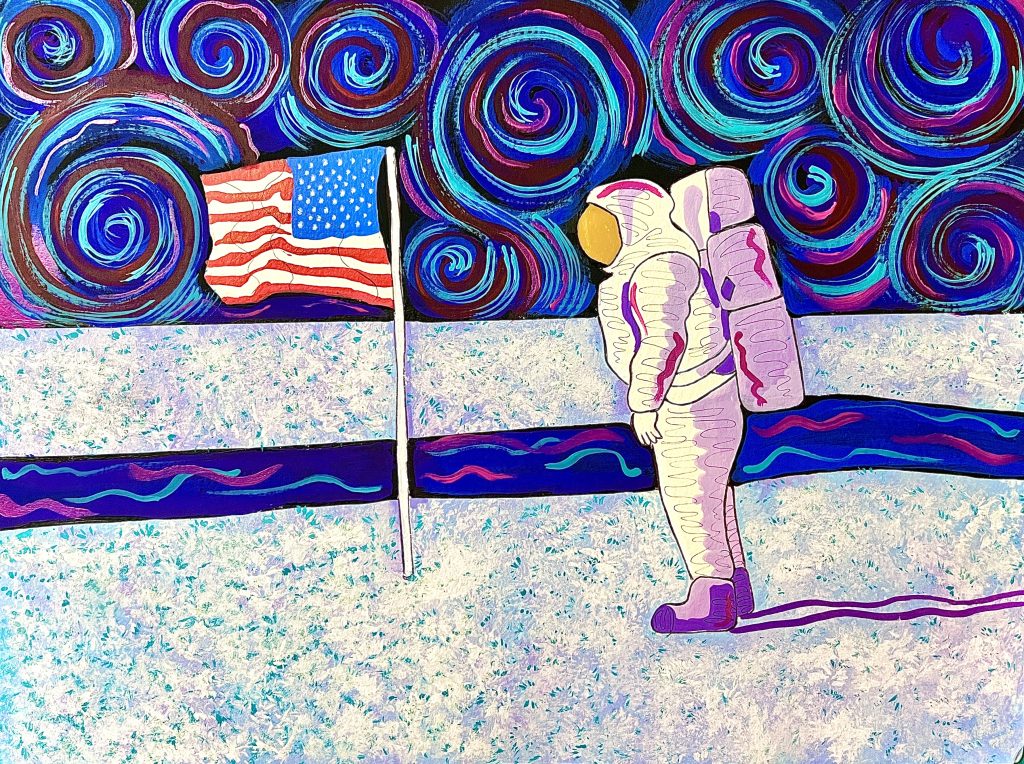
The moon landing was one of history’s most remarkable achievements. On July 20, 1969, during the Apollo 11 Moon Landing, NASA astronauts became the first humans to set foot on the Moon, marking a giant leap in space exploration and scientific discovery. The famous photographs from this mission captured the quiet, dusty landscape of the Moon and the wonder of seeing Earth from afar.
In this lesson, we’ll create our own moon landing-inspired painting using acrylic paints, reimagining the historic scene with brighter, more expressive colors. Drawing a touch of inspiration from The Starry Night by Vincent van Gogh, students will add movement, texture, and swirling sky effects to give this iconic moment a fresh artistic twist while still honoring the spirit of exploration and discovery.

Supplies Needed:
- 9×12 inch watercolor or mixed media paper
- acrylic paints (black, white, lavender, light blue, teal, blue, red, metallic gold or yellow)
- ballpoint pen or marker
- assorted brushes
History & Geography
In this session, we have included a brief history of the culture and events that shaped the Modern Era. Get a taste of the fashion, the music, the television and films, and the key events of the 1950s and 1960s!
Additionally, we have included several videos diving more into these various topics in-depth. You can find them below!
Parent Preview Disclaimer:
Some of the videos listed below contain a few minor swear words. We encourage you to preview the video selections before sharing them with your children to ensure you are comfortable with the material. Please use your own discretion as a parent.
PBS Documentary – The 1950s, Segment One
The Fifties: “The Road to the Sixties”
Moon Landing Declassified – National Geographic
The Civil Rights Movement – Strategies, Resistance, and Change
History Brief: 1960s Daily Life and Pop Culture
Elvis Prestley – A Boy From Tupelo
The History of the Beatles
Family Life: (1949 Short Instructional Film)
Mid Century Home Life – (1950s Short Instructional Film)
Vintage 1950s and 60s Commercials
1950s Suburban Life (Vintage Home Commercial)
I Love Lucy Colorized Intro
Leave it to Beaver Intro
Solfa
Charlotte Mason incorporated solfa lessons twice a week for about 10 minutes each. These lessons are intended to be repeated and you can stay on any lesson for as long as you like. Here is the YouTube channel Lara and her boys enjoy and recommends for practicing solfa, Children of the Open Air:
Brush Drawing
Brush drawing builds motor and observation skills. We have included a link to videos by Bestowing the Brush below which are great for all ages to learn together:
