
Welcome to the Age of Exploration Morning Time Session!
Click on the button above to download the entire PDF,
or download only the sections you want below.
Schedule
Recommended Books
Prayer & Scripture Memorization
For Bible reading, we will make suggestions for your morning time reading. However, if you’d prefer a more in depth schedule, we recommend checking out various plans that will help you read the Bible through.
For a one-year plan, we recommend YouVersion’s One Year Bible: https://www.bible.com/readingplans/60. You can also listen to it being read aloud on the app.
Download a two-year reading plan from the Gospel Coalition here:
https://media.thegospelcoalition.org/static-blogs/tgc/files/2010/12/TGC-Two-Year-Bible-ReadingPlan1.pdf
If you prefer to go even slower, Ambleside Online offers three, four, and five-year Bible reading
plans: https://www.amblesideonline.org/L/Lbiblesch.html
This session, we will learn The Ship of Life Prayer and focus on writing and memorizing Matthew 28:18-20, Mark 16:15, and Acts 1:8
Artist Study
This session’s featured artist is Albrecht Dürer. We’ve included six art selections for your kids and teens to use for picture study. They are:
- Portrait of Emperor Maximilian I
- Portrait of a Venetian Woman
- Young Hare
- The Rhinoceros
- Feast of the Rose Garlands
- Adoration of the Trinity
Composer Study
This session’s featured composer is Tomás Luis de Victoria. We have included six of his pieces for music study. They are:
- O Magnum Mysterium
- Tenebrae Responsories, Part One
- Tenebrae Responsories, Part Two
- Requiem Mass, 1605
- Requiem: Missa Pro Defunctis, Part One
- Requiem: Missa Pro Defunctis, Part Two
Listen to each piece below:
O Magnum Mysterium
Tenebrae Responsories
Requiem Mass, 1605
Requiem: Missa Pro Defunctis
Hymn/Folk Song
Hymn
“O Love, How Deep, How Broad, How High” is a beautiful depiction of Christ’s all-encompassing love for us. Written in the 15th century as a Latin text by an anonymous author, “O amor quam ecstaticus!” was translated hundreds of years later into English by a priest by the name of Benjamin Webb. Each of the stanzas of “O Love, How Deep, How Broad, How High” shows a different way Christ showed sacrificial love to humanity, from the time he was born on earth through his earthly ministry, death, and eventual resurrection. Even now, this old hymn from the 15th century echoes a timeless message that still rings true in the modern age.
Listen to the music and sing along with it below:
O Love, How Deep, How Broad, How High
Folk Song
“The Golden Vanity” is a traditional folk song from the 17th century that tells the story of a brave young cabin boy aboard a great ship. The song has gone by many names over the years, and is sometimes called “The Sweet Trinity,” which is the name of the ship in several versions. However, the earliest known title, dating back to 1625, was “Sir Walter Raleigh Sailing in the Lowlands.” It likely began as a sea ballad sung by sailors while working on ships. Songs like this helped pass the time, kept a steady rhythm for labor, and allowed sailors to share stories of bravery and hardship. Although its lyrics are not historically true, it captures the spirit of life at sea during the Age of Exploration, when ships were central to travel, trade, and discovery.
Listen and sing along with it below:
The Golden Vanity
Poetry
Our featured poet for this session is Sir Walter Raleigh, a famous Renaissance writer. We’ve included six poetry selections for your kids and teens to read, listen to, memorize, and recite. They are:
- As You Came from the Holy Land
- The Passionate Man’s Pilgrimage
- The Nymph’s Reply to the Shepherd
- Song of Myself
- Hymn
- Now What is Love
For copywork, we have included Zaner-Bloser style handwriting sheets for primary, elementary, and cursive, as well as college ruled for older students. We have chosen three poems to copy, listed below:
- The Passionate Man’s Pilgrimage
- Song of Myself
- Hymn
Copywork
Tea Times
In this session, we are giving you six Age of Exploration-inspired recipes for our tea time: Pastel de Nata, Bread Pudding, Cherry Clafoutis, Speculaas, Torrijas, and Giobi.
We will also have six tea-time reading selections:
Story Time Tea: Winnie the Pooh, Ch. VIII, “In Which Christopher Robin Leads An Expotition to the North Pole,” by A. A. Milne
Historical Tea: A Journal of the First Voyage of Vasco da Gama, by Anonymous.
Historical Tea: The Memoirs of the Conquistador Bernal Díaz de Castillo Part One: The Conquest of New Mexico and Spain, by Bernal Díaz de Castillo
Story Time Tea: Don Quixote, by Miguel de Cervantes Saavedra
Story Time Tea 5: The Pilgrim’s Progress, Every Child Can Read by John Bunyan
Story Time Tea: Sea Lore and Legends
Plutarch
For our Plutarch selection, we have chosen the chapter “Three Powers,” a study of Lysander from The Children’s Plutarch: Stories of the Greeks, and included it on the following pages.
The book may also be purchased on Amazon.
Nature Study
Each Friday morning, you will go through two of our nature cards. They are labeled in the upper right corner with the corresponding week. These are short, factual cards with images to help your child become familiar with objects in the natural world.
As you progress through our sessions, you may find it handy to keep your past nature cards in a binder for easy reference when your children come across a familiar object. These seeds you are planting will grow into a wonderful garden of knowledge for your children in years to come.
As you explore nature outside your home, watch and listen for newly discovered delights.
Handicraft
For our handicraft lesson, we will be gilding a picture frame. Working with gold leaf is an intricate and sometimes tedious process that requires a great deal of patience. We suggest practicing on a smaller frame or object, and not one as ornate as the frame we used in this project.
For younger students wanting to learn, simply use a canvas or watercolor paper. Let them “paint” a design on it with glue or ModPodge. Then, as it begins to feel tacky, lay the gold leaf over it to produce their gilded design. The same process of brushing found in the following instructions will apply.
Art Lesson
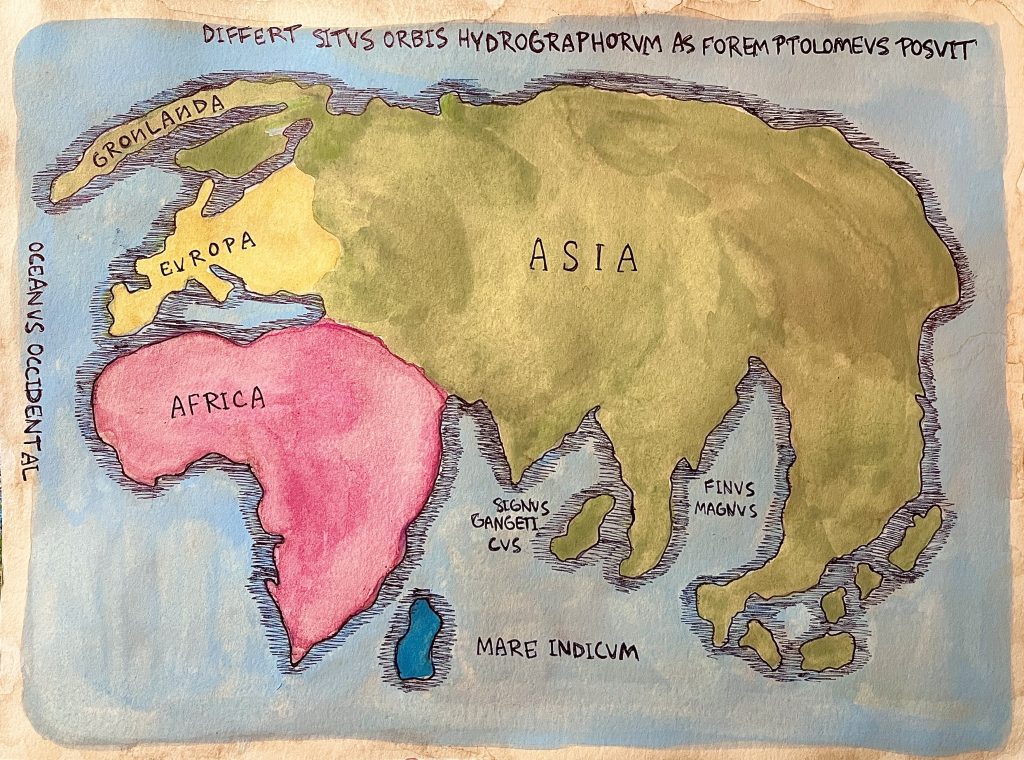
Step back in time and create a map inspired by the “Old World,” as it might have appeared before the voyages of Christopher Columbus and the discovery of the Americas. In this lesson, we design their own aged map using simple mixed-media techniques that give the artwork an authentic, antique look. Using coffee as our base, we’ll create a warm, weathered background—much like the look of old parchment—that makes the colors beautifully faded and timeworn. The result is a richly textured map that looks as though it could have come straight from a centuries-old explorer’s journal.
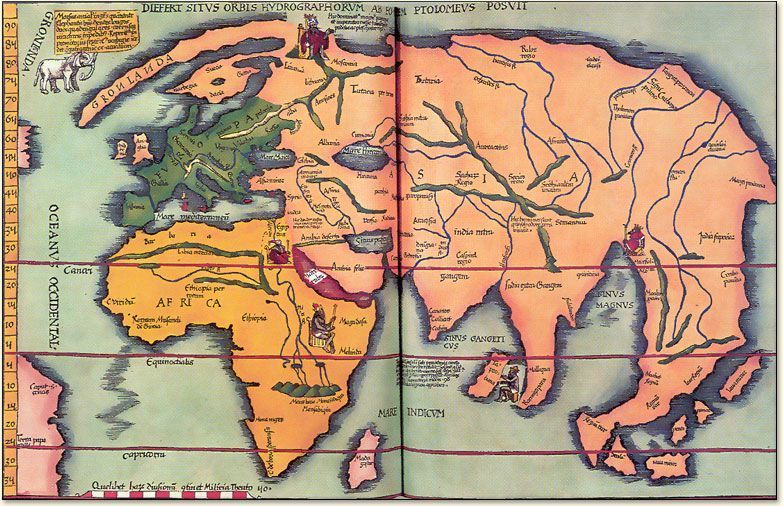
The map’s shape and design was inspired by this map of the Old World. Follow the outlined template provided below, or use this and other maps to create your own version of what people imagined the earth might have looked like in the olden days!
Supplies List
- 9×12 inch watercolor paper
- acrylic paints (light blue, green, pink or red, yellow, blue)
- watercolor paintbrush
- coffee (cooled)
- ballpoint pen
History & Geography
In this session, we have included mini biographies of ten notable Age of Exploration explorers!
Your family may also enjoy reading The World of Columbus and Sons, by Genevieve Foster. Below is a free version, and also a link to Amazon if you wish to purchase your own copy. There are five sections which you can spread over the next five (or six) weeks.
We have also included maps from between the 15th and 17th centuries, as well as some created before the Age of Exploration, to amuse your family! Compare and contrast them with a modern world map.
What Started the Age of Exploration? (Parent disclaimer: Some cartoonish blood/fake bodies for a moment at 18:56-19:10.)
How Christopher Columbus Found the New World
How Did Europeans Immigrate to the Americas?
Ferdinand Magellan – First Circumnavigation of the Earth
Francis Drake Sails Around the World
Who Was Amerigo Vespucci?
How Did the Great Explorers Avoid Getting Lost at Sea?
How Did A Whole Village Disappear? (The Lost Colony of Roanoke Mystery)
The Geography of Spices and Herbs
Solfa
Charlotte Mason incorporated solfa lessons twice a week for about 10 minutes each. These lessons are intended to be repeated and you can stay on any lesson for as long as you like. Here is the YouTube channel Lara and her boys enjoy and recommends for practicing solfa, Children of the Open Air:
Brush Drawing
Brush drawing builds motor and observation skills. We have included a link to videos by Bestowing the Brush below which are great for all ages to learn together:
