
Welcome to the Renaissance Morning Time Session!
Click on the button above to download the entire PDF,
or download only the sections you want below.
Schedule
Recommended Books
Prayer & Scripture Memorization
For Bible reading, we will make suggestions for your morning time reading. However, if you’d prefer a more in depth schedule, we recommend checking out various plans that will help you read the Bible through.
For a one-year plan, we recommend YouVersion’s One Year Bible: https://www.bible.com/readingplans/60. You can also listen to it being read aloud on the app.
Download a two-year reading plan from the Gospel Coalition here:
https://media.thegospelcoalition.org/static-blogs/tgc/files/2010/12/TGC-Two-Year-Bible-ReadingPlan1.pdf
If you prefer to go even slower, Ambleside Online offers three, four, and five-year Bible reading
plans: https://www.amblesideonline.org/L/Lbiblesch.html
This session, we will learn Luther’s Morning Prayer and focus on writing and memorizing Psalm 46.
Artist Study
This session’s featured artist is Leonardo Da Vinci. We’ve included six art selections for your kids and teens to use for picture study. They are:
- Ginevra de’ Bencik,1478
- Virgin of the Rocks, 1483–1486 (Louvre Version)
- Lady with an Ermine, 1489
- The Last Supper, 1498
- Salvator Mundi, 1500
- Mona Lisa, 1503-1517
Composer Study
This session’s featured composer is Josquin des Prez. We have included six of his pieces for music study. They are:
- Missa Pange lingua
- Miserere mei, Deus
- Ave Maria, Virgo Serena
- Missa l”Homme Armé Super Voces Musicales
- Missa Hercules dux Ferrariae
- Missa de Beata Virgine
Listen to each piece below:
Missa Pange lingua
Miserere mei, Deus
Ave Maria, Virgo Serena
Missa l”Homme Armé Super Voces Musicales (Note- we recommend taking in the full piece by listening to the entire playlist below.)
Missa Hercules dux Ferrariae
Missa de Beata Virgine
Hymn/Folk Song
Hymn
The hymn “Come Down, O Love Divine” is one of those songs that feels both timeless and deeply moving. The words of this hymn were first written in the 14th century by an Italian poet named Bianco da Siena. His verses were written in Italian and were simple prayers asking for the Holy Spirit to fill the believer’s heart with love.
The hymn became even more well-known in the 19th century when the English priest Richard Frederick Littledale translated Bianco’s Italian poem into English. Later, the musical accompaniment known today was written by Ralph Vaughan Williams, a famous English composer in the early 20th century, who loved to restore old melodies. The result is the hymn we sing today: a Renaissance poem set to a beautiful modern melody.
Listen to the music and sing along with it below:
Come Down, O Love Divine – King’s College, Cambridge Choir
Folk Song
“Scarborough Fair” is a traditional English ballad whose earliest known versions date to the late medieval and early Renaissance periods. It tells of a young man sending a list of impossible tasks to a former lover as a condition for reconciliation. This structure of poetic riddles and “impossible tasks” is common in European folk songs of the time. The haunting, modal melody gives it a distinctly old-world sound, echoing the music heard in 16th-century England.
Listen and sing along with it below:
Scarborough Fair – MALINDA
Poetry
Our featured poet for this session is Ben Jonson, a famous Renaissance writer. We’ve included six poetry selections for your kids and teens to read, listen to, memorize, and recite. They are:
- X: Song: To Celia
- Of Life and Death
- On a Robbery
- A Fit of Rhyme Against Rhyme
- Hymn to the Belly
- A Hymn to God the Father
For copywork, we have included Zaner-Bloser style handwriting sheets for primary, elementary, and cursive, as well as college ruled for older students. We have chosen three poems, as well as a historical speech to copy, listed below:
- Of Life and Death
- On a Robbery
- A Hymn to God the Father
- (History copywork) Queen Elizabeth’s Tilbury Speech
Copywork
Tea Times
In this session, we are giving you six Renaissance recipes for our tea time: Pumpkin Torte, Fruit and Nut Pie, Rose Water Bread, Fruit-Filled Cinammon Twists, Mostaccioli a la Romana (Almond Cakes), and Castagnaccio (Italian Chestnut Cake).
Additionally, we have included a short biography of a famous Renaissance-era chef.
We will also have six storytime teas:
Fairy Tale Tea 1: Cinderella, or the Little Glass Slipper, by Andrew Lang
Fable Tea 2: The Hare and the Tortoise, by Aesop
Fairy Tale Tea 3: Rapunzel, by the Brothers Grimm
Fable Tea 4: The Shepherd Boy and the Wolf, by Aesop
Fairy Tale Tea 5: Hansel and Grettel, by Andrew Lang
Fable Tea 6: The Lion and the Mouse, by Aesop
Plutarch
For our Plutarch selection, we have chosen the chapter “The Man Who Made Athens Beautiful,” a study of Pericles from The Children’s Plutarch: Stories of the Greeks, and included it on the following pages. The book may also be purchased on Amazon.
If your children are 6th grade or older, we recommend spending a full 12-week term studying Pericles with the edited (for length and content) study guide from Ambleside below.
You can also purchase the guide by Anne White on Amazon. (This is in place of The Children’s Plutarch, not in addition to.)
Nature Study
Each Friday morning, you will go through two of our nature cards. They are labeled in the upper right corner with the corresponding week. These are short, factual cards with images to help your child become familiar with objects in the natural world.
As you progress through our sessions, you may find it handy to keep your past nature cards in a binder for easy reference when your children come across a familiar object. These seeds you are planting will grow into a wonderful garden of knowledge for your children in years to come.
As you explore nature outside your home, watch and listen for newly discovered delights.
Handicraft
For our handicraft lesson, we will be gilding a picture frame. Working with gold leaf is an intricate and sometimes tedious process that requires a great deal of patience. We suggest practicing on a smaller frame or object, and not one as ornate as the frame we used in this project.
For younger students wanting to learn, simply use a canvas or watercolor paper. Let them “paint” a design on it with glue or ModPodge. Then, as it begins to feel tacky, lay the gold leaf over it to produce their gilded design. The same process of brushing found in the following instructions will apply.
Art Lesson
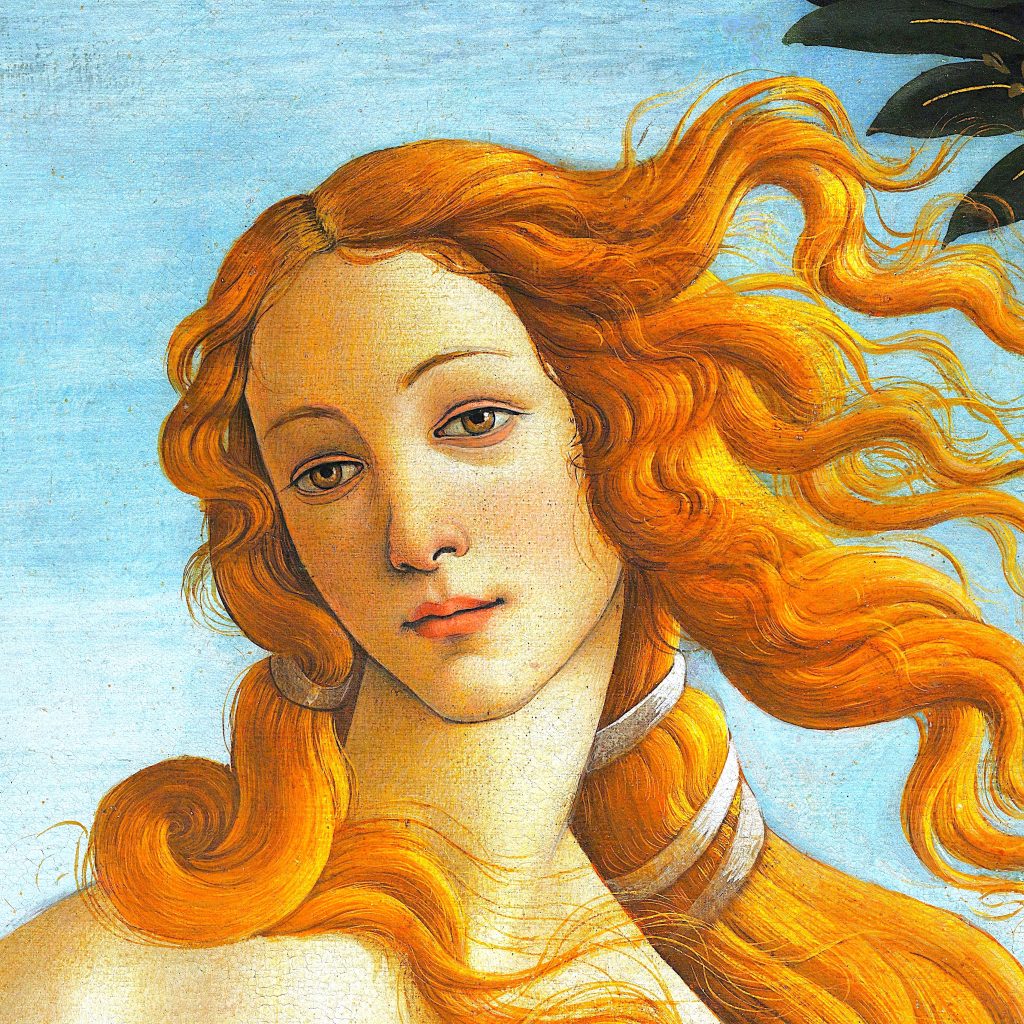
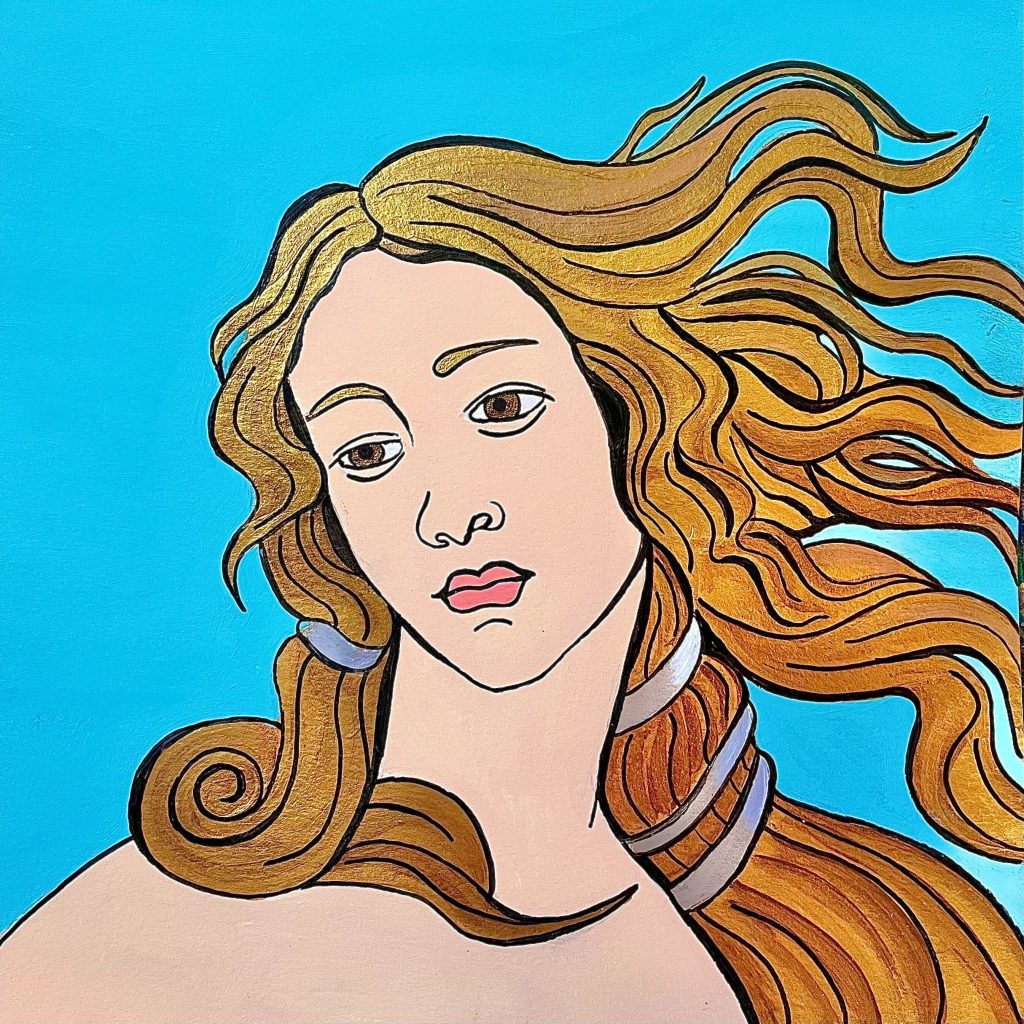
“The Birth of Venus” is a famous painting by Sandro Botticelli, a prominent artist during the Renaissance. Inspired by Greek mythology, it tells the story of how Venus, the most beautiful woman in the world, was born out of the ocean.
We will be painting Venus’ face. Botticelli painted her with smooth, delicate brushstrokes that almost made her seem to glow. Her expression is calm and gentle, with soft eyes and long, luscious hair. In this lesson, we will focus on her hair, using metallic gold paint so that it shimmers on the page.
Supplies Needed:
- 9×12 watercolor paper
- Acrylic paints (metallic gold, metallic silver, metallic copper, metallic rose gold, flesh tone, pale blue or teal, pink, white)
- Paintbrush
- Black marker or sharpie
- White paint pen
History & Geography
In this session, we have included two books to read for history and geography. The links to download or purchase these books are included in the history and geography section online. We have also included two maps for you to study and use for map drills.
History: The Story of Mankind (TSOM) Chapters 39-44. This book is linked for free below.
Optional: For a well-rounded overview of the Renaissance and Reformation, we also recommend The World of Columbus and Sons, by Genevieve Foster.
Geography: Book of Marvels: The Occident, Ch. 23 “St. Peter’s, ” Ch. 26 “The Heart of Russia,” and Ch. 30 “The Mother of All Churches.”
The link to purchase this book is available below, as it is not in the public domain.
Maps: “Northern & Southern Renaissance Map,” “Renaissance Map: Largest Cities (c. 1500)”
Additionally, we have included several videos below containing further information on topics such as Leonardo Da Vinci, Bartolomeo Scappi, and the art, science, and history of the Renaissance.
Parent Preview Disclaimer:
Some of the artwork featured in these videos include classical or historical works of art that contain partial or full nudity. This imagery is common in many masterpieces and reflects the artistic traditions of the time, not modern or sexualized content. We encourage you to preview the video selections before sharing them with their children to ensure you are comfortable with the material. Please use your own discretion as a parent.
Mona Lisa: Leonardo’s Earlier Version
Leonardo, The Mona Lisa – in the Renaissance and today
Bling Cookery from the Renaissance! – Caluccio & The Renaissance Cookbook – BBC (Note- we recommend turning on closed captions for this video for clarity, as the participants have Italian accents.)
The History of Kitchens: Renaissance Edition | From Fork Scandals to Poisonous Tomatoes!
Silly Symphony – The Tortoise and the Hare
The Renaissance Period Explained | All You Need to Know
The Art of Renaissance Science: Galileo and Perspective, Joseph W. Dauben
We also recommend Step into Renaissance Florence, 1475 | A Narrative Art History of the Renaissance: Season 1 Prologue by Narrative Art History, which can be found here: https://www.youtube.com/watch?v=KUm6Z2FkV8k
Solfa
Charlotte Mason incorporated solfa lessons twice a week for about 10 minutes each. These lessons are intended to be repeated and you can stay on any lesson for as long as you like. Here is the YouTube channel Lara and her boys enjoy and recommends for practicing solfa, Children of the Open Air:
Brush Drawing
Brush drawing builds motor and observation skills. We have included a link to videos by Bestowing the Brush below which are great for all ages to learn together:
