
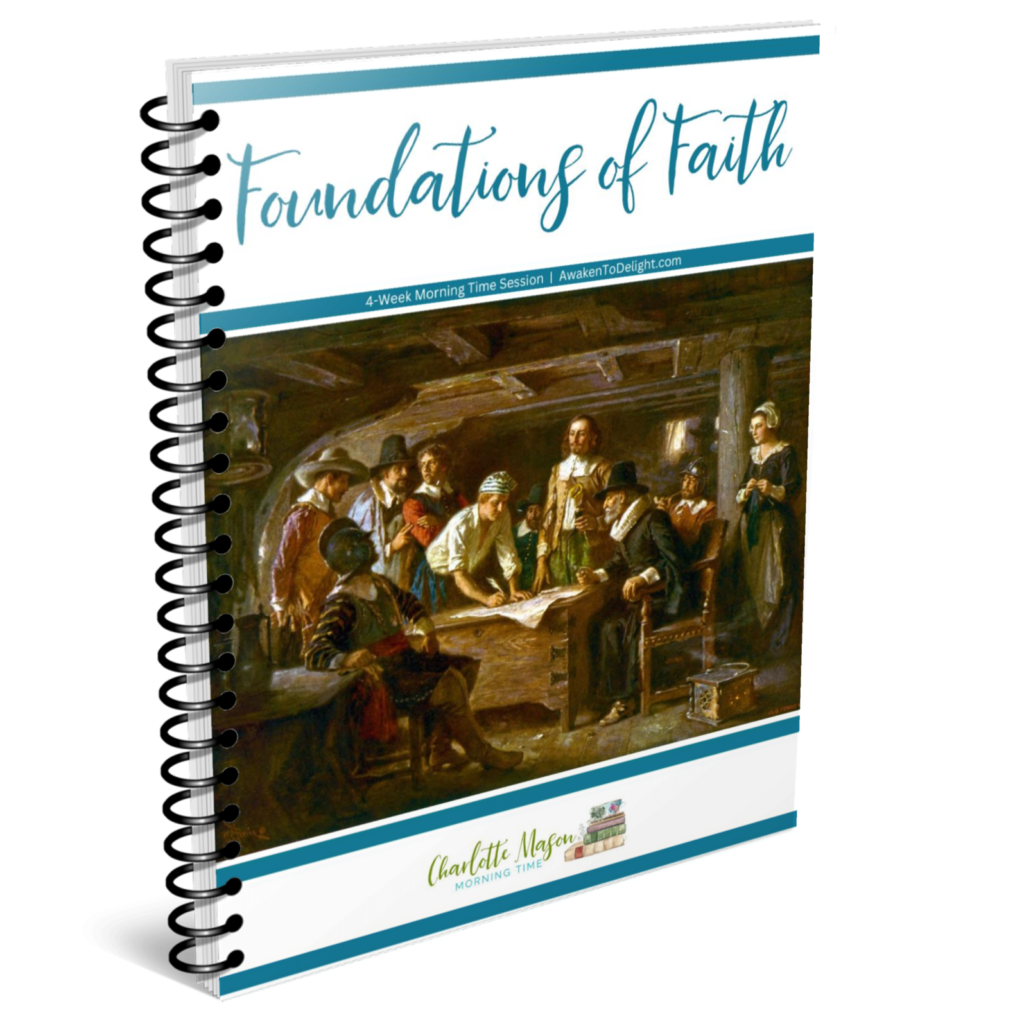
Welcome to the Foundations of Faith Morning Time Session!
This 4-week morning time session focuses on the Puritans coming to start a new life in America and their early years establishing New England, as well as the theme of Thanksgiving and thankfulness.
Click on the button above to download the entire PDF,
or download only the sections you want below.
Schedule
Recommended Books
Prayer & Scripture Memorization
For Bible reading, we will make suggestions for your morning time reading. However, if you’d prefer a more in depth schedule, we recommend checking out various plans that will help you read the Bible through.
For a one-year plan, we recommend YouVersion’s One Year Bible: https://www.bible.com/reading- plans/60. You can also listen to it being read aloud on the app.
Download a two-year reading plan from the Gospel Coalition here: https://media.thegospelcoalition.org/static-blogs/tgc/files/2010/12/TGC-Two-Year-Bible-Reading- Plan1.pdf
If you prefer to go even slower, Ambleside Online offers three, four, and five-year Bible reading plans: https://www.amblesideonline.org/L/Lbiblesch.html
For the Foundations of Faith session you will read through many of the Psalms of thanksgiving and highlight other scriptures that speak of thankfulness.
Your students will memorize Psalm 100 and A Puritan Prayer: The Valley of Vision.
We have also supplied extra copywork sheets of a few more thanksgiving/thankfulness scriptures for your students to work on if you’d like. (They are included after A Puritan Prayer copywork.)
Artist Study
This session’s featured artist is Rembrandt van Rijn. We’ve included four art selections for your kids and teens to use for picture study. They are:
- Rembrandt Laughing
- Belshazzar’s Feast
- Saul and David
- A Woman Holding a Pink
Composer Study
Our featured composer is John Dowland. We’ve included four of his pieces (with links to each) to listen to. They are:
- Lachrimae
- Flow My Tears
- Can She Excuse My Wrongs?
- Psalm 100 (The Old Hundredth)
Listen to each piece below:
Lachrimae
Flow My Tears
Can She Excuse My Wrongs
Full Disclosure: I’ve been a Sting fan since the 80s, 🥰 but I chose this video because he does all four parts of harmony himself, and shows how the men would have sat around the songbook to sing.
Psalm 100
Hymn/Folk Song
Hymn
The hymn, “Now Thank We All Our God,” was written by Martin Rinkart in 1636 during the Thirty Years War. Rinkart served as a Lutheran pastor in Eilenburg, Germany, during a severe plague. He officiated up to fifty funerals a day (including his own wife’s) and ended up presiding over 4,000 funerals in one year. Despite the hardships and tragedies of the war and the plague, Rinkart’s words express gratitude and praise to God for His blessings and provision.
The hymn was first published in Rinkart’s book of church music in 1647 and later translated into English by Catherine Winkworth in 1863. It has been included in numerous hymnals and is still widely sung today in both its original German and English versions. Its memorable melody, composed by Johann Crüger in 1647, has even been used in J.S. Bach’s cantatas, harmonized for four voices, and set in a chorale prelude.
In addition to being a beloved hymn of thanksgiving, “Now Thank We All Our God” has also been used as a national anthem. It served as the unofficial national anthem of Prussia until 1922 and was also adopted by Germany during the Weimar Republic. Today, it is the official hymn of the Evangelical Church in Germany.
Even amid trials and struggles, Rinkart’s words remind us to pause and give thanks to God for His faithfulness and provision. As we sing these words of gratitude, we join with countless believers throughout history who have lifted their voices in praise to our gracious God.
Listen to the music and sing along with it below:
Folk Song
Our folk song for this session is, “Greensleeves.” Its origins are unclear, but it is believed to date back to the 16th century. One theory suggests that it was written by King Henry VIII for his mistress and future queen, Anne Boleyn. However, there is no evidence to support this. In fact, the tune seems to be based on an Italian style of composition that did not reach England until after Henry’s death, during the reign of his daughter, Elizabeth I.
According to the book, English Folk-Song and Dance, by Frank Kidson, a broadside ballad by this name was registered at the London Stationer’s Company in September of 1580, by Richard Jones, as “A Newe Northen Dittye of ye Ladye Greene Sleves”. And more ballads of similar titles were registered in less than a year. For example, “Ye Ladie Greene Sleeves answere to Donkyn hir frende,” by Edward White, and “A New Courtly Sonnet of the Lady Green Sleeves.”
Over the centuries, “Greensleeves” has been adapted into various musical styles and interpretations, including classical compositions as well as popular recordings. The melody has also been set to words for the well-known Christmas carol, “What Child Is This?” It remains a beloved and timeless classic.
Listen and sing along with it below:
Poetry
This session’s featured poet is Anne Bradstreet. We’ve included four poetry selections for your kids and teens to read, listen to, memorize, and recite. They are:
- The Author to Her Book
- Before the Birth of One of Her Children
- By Night when Others Soundly Slept
- To My Dear and Loving Husband
For copywork, we have included Zaner-Bloser style handwriting sheets for primary, elementary, and cursive, as well as college ruled for older students of The Mayflower Compact.
Copywork
Tea Times
In this session you will experience some of the foods that the Puritans ate in the 17th century: Indian Corn (Hasty) Pudding, Wampanoag Boiled Bread, and Stewed Pompion (Pumpkin). We also added in Cranberry Scones (not exactly a pilgrim dish, but they did eat cranberries). 😉
We will have a Storytime tea and three Poetry teatimes.
1. Poetry Teatime: “The Pilgrim Fathers,” by Leonard Bacon
2. Poetry Teatime: “Landing of the Pilgrims,” by Felicia Dorothea Hemans
3. Storytime Tea: “An Old-Fashioned Thanksgiving,” by Louisa May Alcott
4. Poetry Teatime: “A Thanksgiving,” by John Kendrick Bangs
Shakespeare
For our Shakespeare selection, we have chosen “All’s Well That Ends Well.”
Read it from Edith Nesbit’s Beautiful Stories from Shakespeare in the following pages. But we also recommend reading the actual play together as a family if you can.
Your older kids and teens may enjoy watching a movie adaptation (please pre-screen these first). And if you can take in a live performance, your family will never forget it!
We are including a link below to watch a pre-recorded stage performance of “All’s Well That Ends Well.”
Watch a performance of “All’s Well That Ends Well,” by Los Alamitos TV below:
Nature Study
Each Friday morning, you will go through two of our nature cards. They are labeled in the upper right corner with the corresponding week. These are short, factual cards with images to help your child become familiar with objects in the natural world.
As you progress through our sessions, you may find it handy to keep your past nature cards in a binder for easy reference when your children come across a familiar object. These seeds you are planting will grow into a wonderful garden of knowledge for your children in years to come.
As you explore nature outside your home, watch and listen for newly discovered delights.
Handicraft
The Pilgrims brought their weaving techniques from England to America and primarily wove fabrics using hand looms and wool from their own sheep. They produced items such as blankets and garments for everyday use.
Pilgrim weaving is now recognized as a distinct style, characterized by its use of bold colors and geometric patterns. These handwoven textiles are highly coveted for their beauty and superior quality, making them valuable pieces in both historical and contemporary contexts.
For our handicraft lesson, we will create a cardboard loom and try our hand at weaving.
Art Lesson

In this lesson, we are going to paint the Plymouth settlement
Supplies needed:
- 8×10 canvas panel or watercolor paper
- Acrylic paints (blue, green, white, yellow, and brown)
- Paint brushes (medium or small flat)
- Paper plate, paper towel, jar of water
History & Geography
Solfa
Charlotte Mason incorporated solfa lessons twice a week for about 10 minutes each. These lessons are intended to be repeated and you can stay on any lesson for as long as you like. Here is the YouTube channel Lara and her boys enjoy and recommends for practicing solfa, Children of the Open Air:
Brush Drawing
Brush drawing builds motor and observation skills. We have included a link to videos by Bestowing the Brush below which are great for all ages to learn together:
